
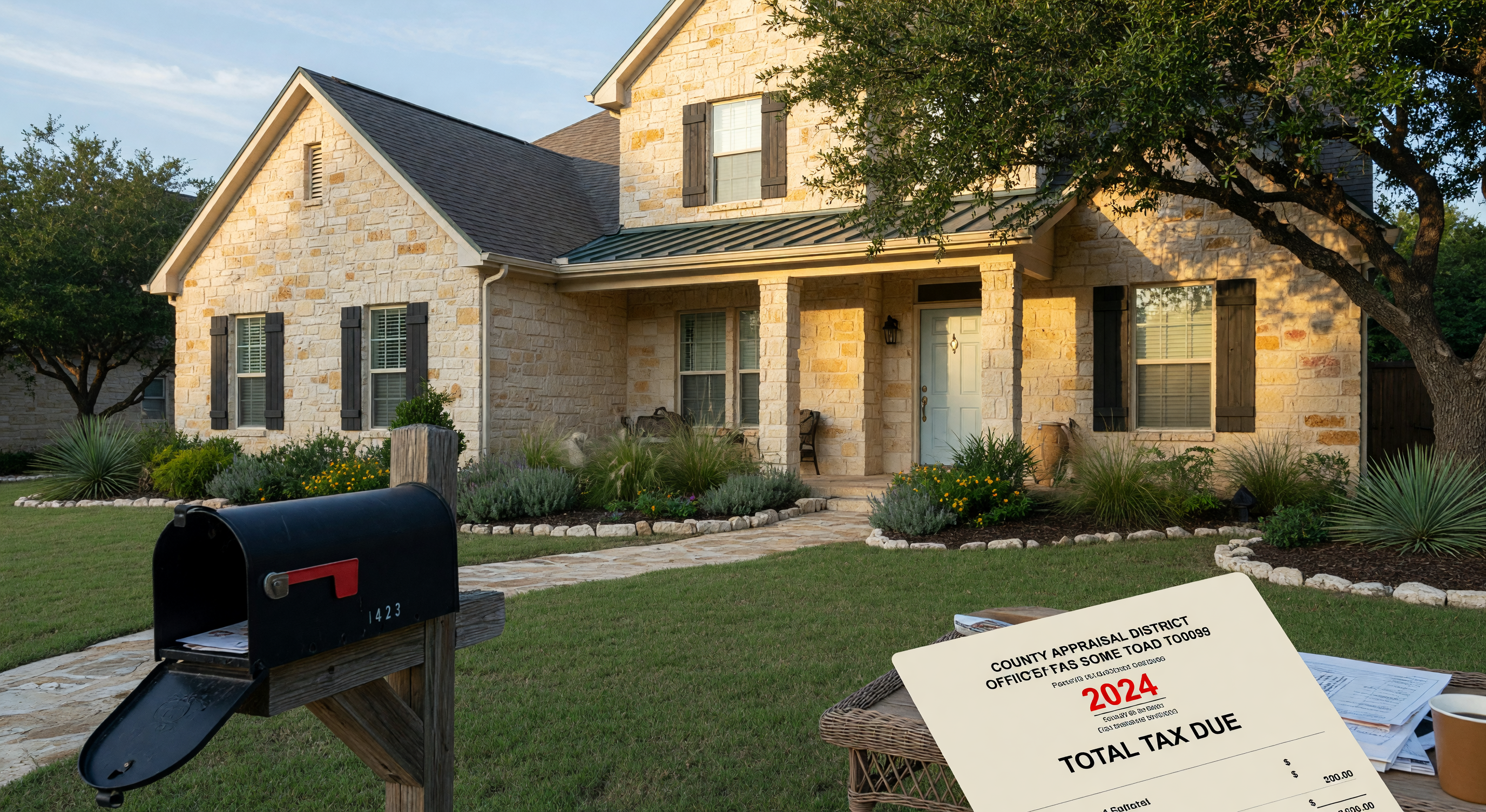
Every week I talk to California buyers who have done the math on their move. They have calculated the sale price of their Bay Area or Los Angeles home, estimated what they can buy in Boerne or Fair Oaks Ranch, and factored in the absence of California's 9.3% to 13.3% state income tax. The savings look enormous. And in many ways, they are.
Then they see the property tax rate. And the calculation changes.
This is not a reason to avoid Texas. It is a reason to understand what you are actually paying, why the system works differently than California's, and how to plan for it before you close on a home. This article breaks down the mechanics, the real numbers, and the strategies that help California buyers budget accurately for Texas property taxes.
What California Buyers Are Used To: The Prop 13 Safety Net
California's Proposition 13, passed in 1978, fundamentally changed how property taxes work in the state. Under Prop 13, a home's assessed value is locked in at the time of purchase. Annual increases are capped at 2% per year, regardless of what the market does. If you bought a home in San Jose for $800,000 in 2015, your assessed value in 2026 is roughly $988,000 — even if the home is now worth $1.4 million.
The combined rate under Prop 13 is typically 1.1% to 1.25% of assessed value. This is the sum of California's base 1% property tax plus all local assessment layers. For that $800,000 purchase, you might pay $9,000 to $10,000 annually in property tax — and that number grows slowly, predictably, by no more than 2% per year.
This creates a powerful psychological anchor. California buyers internalize the idea that property taxes are a manageable, slowly growing expense. They are not prepared for a system where the county appraisal district is required to reappraise your property at or near full market value at least once every three years — and in many Hill Country counties, it does so more frequently. Texas does cap annual increases in a qualified residence homestead's appraised value at 10% (plus new improvements), but that still allows significantly more exposure than California's 2% lock. Non-homestead properties valued at $5 million or less currently qualify for a temporary 20% appraisal increase cap (expiring December 31, 2026 unless the legislature extends it), though properties above $5M receive no cap.
How Texas Property Taxes Actually Work
Texas has no state income tax. That is a real and significant financial advantage. But the state funds its government, schools, roads, and services primarily through property taxes. The result is that Texas property tax rates are among the highest in the nation — typically ranging from 1.6% to 2.5% or more, depending on where you live.
Here is what matters: Texas does not lock in your assessed value at purchase the way California does. The county appraisal district is required to reappraise your property at or near full market value at least once every three years — many Hill Country counties do so more often. Texas is a nondisclosure state, so the sale price is not automatically reported to the appraisal district — the CAD estimates market value independently, using the purchase price as one data point among others. But the tax is not calculated on the appraised market value — it is calculated on the taxable value, which is the appraised value after any applicable appraisal caps, exemptions, and special valuations are applied. Each taxing entity (county, school district, city, special district) may arrive at a different taxable value for the same property, depending on which exemptions that entity honors. Your first tax bill reflects the CAD's appraised value as of January 1 of the year of purchase, adjusted by your own exemptions. Once you file your homestead exemption, annual increases in your appraised value are generally limited to 10% per year (plus new improvements), but your starting point is the CAD's independent appraisal — not a locked-in low base.
And the tax rate is not a single number. It is a composite of rates from multiple overlapping taxing authorities:
- School district tax — the largest component, typically $0.70 to $1.10 per $100 of assessed value
- County tax — generally $0.20 to $0.40 per $100
- City tax (if within city limits) — $0.20 to $0.65 per $100
- Special districts — road, flood control, emergency services, and other levies that vary by location
The combined rate — the sum of every taxing entity's rate, which is the number that actually appears on your tax bill — is what you need to plan around.
"The absence of a state income tax is not free. Texas funds government through property taxes at rates that are two to three times higher than what most California buyers expect. Understand the tradeoff before you commit to a purchase price."
Real Numbers: What a $600,000 Home Actually Costs in Hill Country Taxes
Let us use a $600,000 home — a common price point for California buyers relocating to the Hill Country — and compare the property tax burden across three counties where my clients buy most frequently.
| County | Typical Combined Rate | Annual Tax (No Exemption) | After Homestead Exemption |
|---|---|---|---|
| Kendall County (Boerne) | 1.8%–2.2% | $10,800–$13,200 | $8,280–$10,680 |
| Bexar County (San Antonio) | 1.9%–2.3% | $11,400–$13,800 | $8,760–$11,160 |
| Comal County (New Braunfels) | 1.7%–2.1% | $10,200–$12,600 | $7,680–$10,080 |
These are 2025–2026 estimates based on published tax rates from each county's appraisal district and taxing entities. Your actual bill depends on which school district, city, and special districts apply to your specific property. A home inside Boerne city limits will carry a different total rate than one in unincorporated Kendall County, even though both are "in Kendall County."
The Homestead Exemption: Your Most Important Tax Break
Texas offers a residential homestead exemption that meaningfully reduces your property tax bill. As of 2025, the mandatory school district homestead exemption is $140,000 off your appraised value — increased from the previous $100,000 after voters approved Proposition 13 in November 2025. This is the single largest component of the exemption.
In addition, counties, cities, and special districts may offer optional exemptions of up to 20% of appraised value (with a mandatory minimum of $5,000). The exact amount varies by taxing jurisdiction.
Here is what that looks like in practice on a $600,000 home:
- School district taxable value: $600,000 minus $140,000 = $460,000
- County/city taxable value: $600,000 minus the local exemption (varies — could be $5,000 to $120,000 depending on the jurisdiction)
The school district exemption alone can save you $1,500 to $2,500 per year, depending on the school district's tax rate. For homeowners age 65 or older, there is an additional $60,000 school district exemption on top of the base $140,000 — bringing the total school district exemption to $200,000.
You must file for the homestead exemption with your county appraisal district. It is not automatic. The deadline is April 30 of the year following your purchase. Missing this deadline means you pay full taxes for an entire year — a mistake that costs real money.
Why Rates Vary So Dramatically Within the Same County
One of the least understood aspects of Texas property taxes is how much the rate can change from one neighborhood to the next. Your tax rate is determined by which taxing entities overlap your property — and those entities do not follow neat county lines.
A home in the Boerne Independent School District (ISD) will carry a different school tax rate than a home in Northside ISD, even if both are in Bexar County. For 2025, Comal ISD adopted a total rate of $1.0748 per $100 of assessed value ($0.7248 for maintenance and operations, $0.3500 for debt service). North East ISD in Bexar County adopted $0.9882 per $100.
That difference of roughly $0.09 per $100 may look small, but on a $600,000 home it translates to approximately $540 per year. Multiply that across every overlapping entity — county, city, school, special districts — and the differences between two properties that are 10 miles apart can easily reach $1,500 to $3,000 annually.
Before you make an offer on a home, ask your agent to provide the exact tax rate breakdown for that specific property. Do not rely on county-wide averages.
The Tradeoff: No Income Tax, Higher Property Tax
Texas has no state personal income tax. For a California household earning $200,000, that translates to roughly $16,000 to $18,000 per year in avoided California state income tax (at marginal rates of 9.3% to 10.3% in that bracket). For higher earners, the savings are larger — California's top rate of 13.3% applies to income over $1 million.
The question is not whether you save on income tax. You do. The question is how much of that savings is offset by higher property taxes, and whether your total tax burden — income, property, and sales — actually goes down.
| Tax Category | California (Bay Area) | Texas (Boerne, Kendall Co.) |
|---|---|---|
| State Income Tax ($200K HH income) | ~$16,500 | $0 |
| Property Tax ($600K home) | ~$6,600 (1.1% on locked assessment) | ~$9,600 (after homestead exemption) |
| State Sales Tax | 7.25% base + local (up to ~10.25%) | 6.25% base + local (up to ~8.25%) |
| Estimated Annual Savings Moving to TX | — | ~$10,500–$13,000+ |
For most California buyers, the total tax burden is lower in Texas — often substantially. But the savings are not as dramatic as the "no income tax" headline suggests, and the property tax bill is the reason why. Budget for it honestly from the start.
How to Research, Budget, and Protest: Practical Tips
Research Tax Rates Before You Make an Offer
Every county appraisal district in Texas publishes tax rate information online. The Texas Comptroller's office maintains a property tax database at Texas.gov/propertytaxes where you can look up the specific rates for any address. Ask your agent to pull the complete tax breakdown for any property you are seriously considering — not just the county average, but the exact combination of entities that apply to that parcel.
Budget for Tax Increases
Unlike Prop 13's 2% cap, Texas's homestead cap allows annual increases of up to 10% — five times the California limit. If your neighborhood appreciates 8% in a year, your assessed value can go up 8% under the homestead cap. If it appreciates 15%, your assessed value can only go up 10% (the cap kicks in). Non-homestead properties — investment homes, second homes, and new construction before homestead qualification — are subject to a temporary 20% appraisal increase cap for properties valued at $5 million or less (expiring December 31, 2026 unless extended by the legislature). Properties above $5M receive no cap. A prudent approach is to budget for a 3% to 5% annual increase in your property tax bill, even in a stable market. For a $600,000 home with a $9,600 tax bill, a 5% increase means an additional $480 next year — and the year after that, the increase compounds.
File Your Homestead Exemption Immediately
The deadline is April 30 of the year after your purchase. File as early as possible. The exemption is not retroactive to the full year if you file late — you lose months of savings. This is a simple paperwork task that saves thousands.
Protest Your Appraisal Every Year
Texas property owners have the right to protest their appraised value with the county appraisal district. This is not a radical move — it is a routine practice. About 40% to 60% of property owners in major Texas counties file a protest annually. You can protest on the basis that your home's appraised value is higher than its market value, that the appraisal is unequal compared to similar properties, or that errors exist in the property's description.
The protest process is straightforward. You file by May 15 (or 30 days after your appraisal notice, whichever is later), attend an informal meeting with an appraiser, and if needed, appear before an independent appraisal review board. Many homeowners hire a property tax consultant who works on a percentage of your savings — typically 25% to 35% of the first-year reduction. Even if you handle it yourself, the time investment is modest relative to the potential savings.
Consider the Full Picture
Property tax is the largest single tax expense for most Texas homeowners. But it is not the only factor in your financial decision. When you account for California's income tax, higher sales taxes in many California cities, and the typically higher home prices that drive both purchase costs and ongoing expenses, most California buyers still come out ahead financially in Texas. The key is to plan for the property tax bill with clear eyes, not surprise.
Making the Numbers Work for Your Situation
Every relocation has a unique financial equation. The families who plan well are the ones who understand both sides — the California tax picture they are leaving and the Texas tax picture they are entering — before they commit to a purchase price.
If you are evaluating a move from California, I am happy to walk through the specific numbers for your situation. A ten-minute conversation about your income, your California home's sale price, and your Texas target budget can save you months of miscalculation.
For a deeper cost comparison beyond taxes, see the full cost of living breakdown. For a side-by-side look at Hill Country communities, review the city comparison guide. And for the complete relocation timeline, see the 90-day relocation checklist.

Written by
Bill Ross
Hill Country Homesteads Group, brokered by KW Boerne
Bill Ross is a Texas real estate agent with nearly four decades in high-tech sales and a network of 1,000+ California real estate agents for coordinated cross-state transactions. Recognized in USA Today and The Washington Post for his relocation expertise.
Related Guides
Sources
- Kendall County property tax rates and Boerne ISD rates — Kendall County Appraisal District; Texas Comptroller of Public Accounts. esearch.kendallad.org; comptroller.texas.gov
- Bexar County property tax rates by taxing entity — Bexar County Tax Assessor-Collector; Texas Comptroller of Public Accounts. bexar.org
- Comal County and Comal ISD 2025 tax rates ($1.0748/$0.7248 M&O, $0.3500 I&S) — Comal County Appraisal District; Texas Comptroller of Public Accounts. comalpa.org; comptroller.texas.gov
- North East ISD 2025 adopted rate ($0.9882/$0.6882 M&O, $0.3000 I&S) — North East Independent School District; Bexar County Tax Assessor-Collector.
- Texas homestead exemption increased to $140,000 (Proposition 13, November 2025) — Texas Comptroller of Public Accounts; Ballotpedia. comptroller.texas.gov; ballotpedia.org
- Texas homestead exemption details and filing deadline (April 30) — Texas Tax Code §11.13; Texas Comptroller of Public Accounts. statutes.capitol.texas.gov; comptroller.texas.gov
- California state income tax rates (1%–13.3%) — California Franchise Tax Board. ftb.ca.gov
- California vs Texas total tax comparison — California Franchise Tax Board; Texas Comptroller of Public Accounts. ftb.ca.gov; comptroller.texas.gov
Last reviewed: June 2026. Tax rates reflect 2025–2026 published data. Individual rates vary by property location; verify with your county appraisal district.