
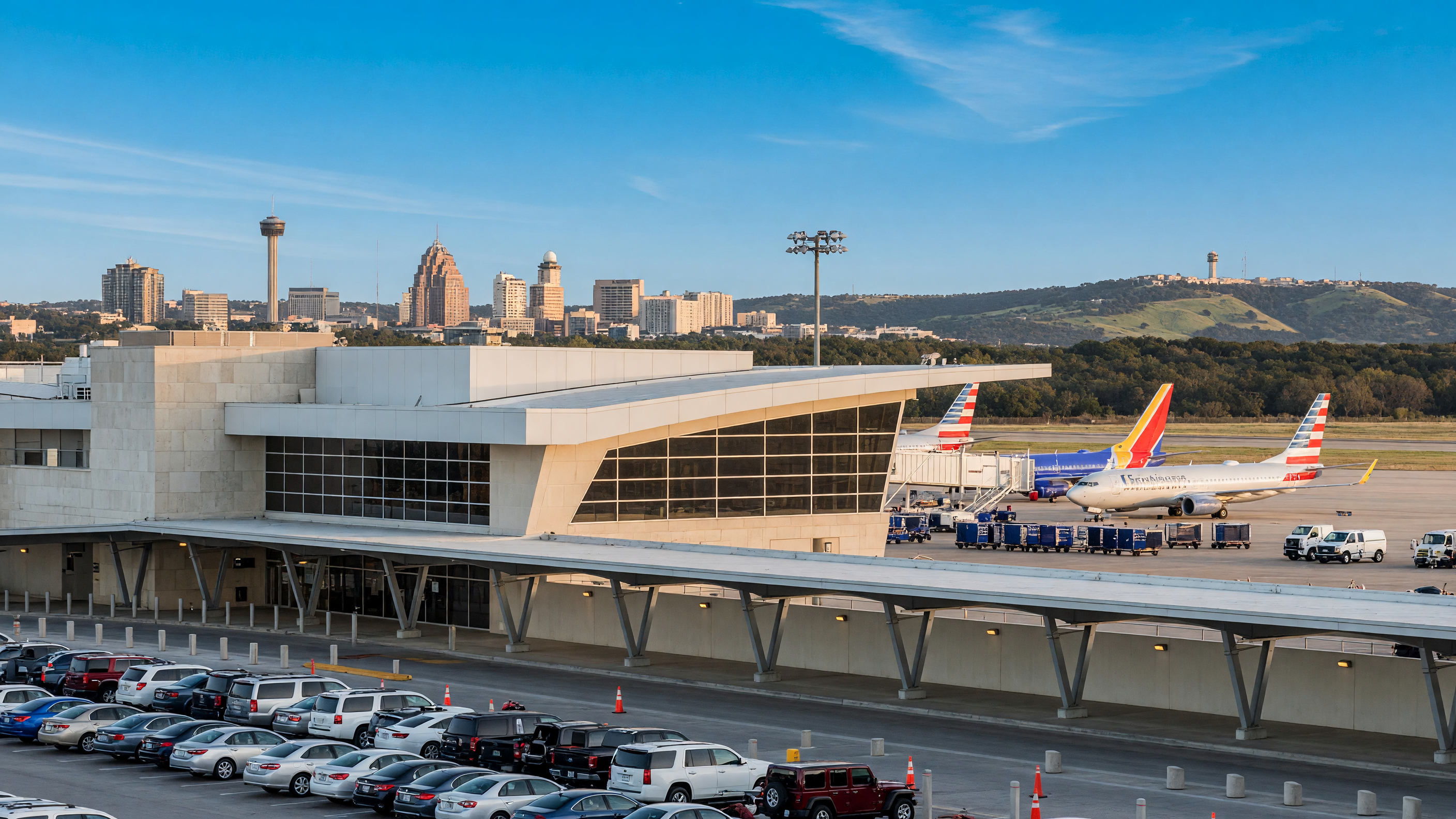
One of the first questions California relocators ask — sometimes before they even start looking at houses — is: how easy is it to fly home? It is a reasonable concern. You have family in Sacramento, friends in the Bay Area, a kid at UCLA, or a business you still need to visit regularly. The Hill Country is a 1,500-mile flight from California, and the airport you use matters. For most Hill Country residents, that airport is San Antonio International (SAT). This article tells you what to expect — drive times, flight options, parking, costs, and the practical realities that listings and relocation guides tend to gloss over.
Getting to the Airport: Drive Times from the Hill Country
San Antonio International Airport sits in the northern part of San Antonio, just off I-418 (Airport Boulevard) and accessible via I-10 and US-281. Its location makes it reasonably accessible from Hill Country communities — but "reasonably accessible" is relative, and the drive times vary more than most people expect.
| From | Distance | Typical Drive Time | Notes |
|---|---|---|---|
| Boerne | ~25 miles | 25–30 minutes | Via I-10 East; can extend to 35–40 min during peak hours |
| Fair Oaks Ranch | ~22 miles | 20–25 minutes | Slightly closer via I-10; 30 min during rush hour |
| San Antonio (north side) | ~10 miles | 15–20 minutes | Direct via US-281 or I-410 |
| New Braunfels | ~45 miles | 40–50 minutes | Via I-35 through San Antonio; variable traffic |
| Austin-Bergstrom (AUS) | ~80 miles from Boerne | 75–90 minutes | Alternate airport; longer drive but sometimes cheaper flights |
For Hill Country families, San Antonio International is the practical airport. The 20 to 30 minute drive from Boerne or Fair Oaks Ranch is manageable for most trips — it is roughly equivalent to what many Bay Area residents drive to get to SFO, or what Los Angeles drivers navigate to reach LAX. The difference is that Hill Country traffic is lighter and more predictable than California metro traffic. You will not hit a two-hour gridlock on I-10 heading to SAT the way you might on 101 heading to SFO.
One practical tip: for early morning flights (before 7:00 AM), add 10 minutes to your estimated drive time. The I-10 corridor through the eastern edge of Boerne can see moderate traffic from 6:30 to 7:30 AM as San Antonio commuters head east and Hill Country residents head to the airport.
Airlines and Direct Flights to California
San Antonio International is a mid-size airport with over 45 nonstop destinations. The California connectivity is decent but not comprehensive. Here is the current picture for direct flights to California cities:
- Southwest Airlines operates the most California routes from SAT, with nonstop service to Los Angeles (LAX), Oakland (OAK), and Burbank (BUR). Southwest is often the most affordable option and does not charge for checked bags — a practical advantage for family travel.
- United Airlines offers nonstop service from SAT to San Francisco (SFO). This is the primary direct option for Bay Area travelers. United also offers connecting service through Houston (IAH) and Denver (DEN) to other California cities.
- American Airlines connects through Dallas/Fort Worth (DFW) to California destinations. No direct California routes from SAT, but the DFW connection is frequent and reliable.
- Other carriers — Alaska Airlines, JetBlue, and others serve SAT but typically do not offer direct California routes. Connections are available through their hubs.
The practical reality: if you are flying to LAX, SFO, or Oakland, you can usually find a direct flight from SAT. If you are flying to San Diego, San Jose, Sacramento, or a smaller California city, you will likely connect through DFW, Houston, Denver, or Phoenix. This adds 1 to 3 hours to your total travel time but is generally manageable.
Flight Times: San Antonio to California
Nonstop flight times from SAT to California cities are shorter than most people expect. The flight path is generally westbound across the desert Southwest, and prevailing tailwinds can make westbound flights slightly longer than the return.
| Route | Nonstop Flight Time | Typical One-Way Fare |
|---|---|---|
| SAT → LAX | 3 hours 10 minutes | $120–$300 (varies by carrier and timing) |
| SAT → SFO | 3 hours 30 minutes | $150–$350 |
| SAT → OAK | 3 hours 20 minutes | $100–$250 (Southwest) |
| SAT → SAN | 3 hours (typically 1 stop) | $150–$350 |
| SAT → SJC | 4–5 hours (1 stop typical) | $150–$400 |
For California relocators who fly back regularly, the key takeaway is this: a direct flight from SAT to LAX or SFO is roughly 3 to 3.5 hours. Add the 25-minute drive from Boerne, the recommended 90-minute airport arrival buffer, and you are looking at a total door-to-door travel time of approximately 5 to 6 hours. For comparison, driving from Boerne to LAX would take 20 to 22 hours. Flying is clearly the answer for California trips — and the flight times are comparable to what you would have experienced flying between California cities.
Parking at SAT: Options and Costs
Parking is one of the smaller logistical considerations, but it matters for frequent flyers. San Antonio International offers several options:
| Parking Option | Daily Rate | Notes |
|---|---|---|
| Short-term garage | $24–$29/day | Connected to terminal; best for short trips (1–3 days) |
| Long-term garage | $14–$16/day | Covered; shuttle to terminal; good for week-long trips |
| Economy lot | $8–$10/day | Open-air; shuttle to terminal; best for extended trips |
| Off-site lots | $3–$8/day | Private operators near airport; shuttle service; book online in advance |
For a family taking a week-long trip back to California, economy lot parking runs approximately $56 to $70. An off-site lot can bring that down to $21 to $56. These are modest costs compared to California airport parking, where SFO long-term can exceed $25 per day and LAX economy structures are similarly priced.
A practical alternative for Hill Country families: arrange a ride to the airport. The 25-minute drive from Boerne is short enough that having a family member drop you off (and pick you up) is entirely practical and eliminates parking costs entirely. For solo travelers, a rideshare from Boerne to SAT runs approximately $25 to $40.
San Antonio (SAT) vs. Austin-Bergstrom (AUS): Which Airport?
Some California relocators consider Austin-Bergstrom International (AUS) as an alternative to SAT. Austin is a larger airport with more direct routes and sometimes lower fares, particularly on budget carriers. The question is whether the longer drive justifies the potential savings.
- Drive time from Boerne to AUS: 75 to 90 minutes via I-10 to TX-130 or I-35. This is a significant difference from the 25 to 30 minute drive to SAT.
- Drive time from Fair Oaks Ranch to AUS: 70 to 85 minutes, similar to Boerne.
- Flight options from AUS: Austin has more direct California routes than SAT, including service to SJC, SMF (Sacramento), and more frequent flights to LAX and SFO. Southwest, JetBlue, Alaska, and other carriers offer competitive pricing.
- Total door-to-door time: For a flight to LAX, the total time from Boerne via AUS (80 min drive + 90 min arrival + 3 hr flight) is roughly 5 hours 40 minutes. Via SAT (25 min drive + 90 min arrival + 3 hr 10 min flight), it is roughly 5 hours 25 minutes. The difference is small — but it is consistently in SAT's favor.
My recommendation for Hill Country families: use SAT as your primary airport. The drive time advantage is meaningful for the frequency of trips most families take. Reserve AUS for occasions when the fare difference is substantial (more than $100 to $150 per ticket) or when SAT does not have a direct route to your California destination and the AUS connection is significantly better.
Tips for Frequent Flyers
If you plan to fly back to California regularly — visiting family, maintaining business ties, or simply staying connected — these practical tips will save you time and money:
Best Days to Fly
Tuesday, Wednesday, and Saturday are consistently the least expensive and least crowded days to fly from SAT. Friday afternoon and Sunday evening are the busiest — avoid them if flexibility allows. For the best fares, book 3 to 6 weeks in advance on domestic routes.
Getting Through SAT Efficiently
SAT is a manageable airport — it is not the sprawling complex that LAX or SFO can be. Security wait times are generally 10 to 20 minutes, though they can extend during peak holiday travel. TSA PreCheck ($78 for 5 years) and Clear ($189 per year) are both available at SAT and worth the investment if you fly more than 6 to 8 times per year. The time savings are significant, particularly during holiday periods when California-bound flights are crowded.
Lounge Options
SAT offers several lounge options. The USO Lounge (available to military and families) is complimentary. The Club at SAT (day pass ~$40 or included with Priority Pass membership) offers a quieter space with complimentary food, drinks, and Wi-Fi. For frequent travelers, a credit card with Priority Pass membership can provide lounge access at SAT and at California airports.
Southwest for Families
For California-bound families, Southwest Airlines deserves particular attention. Two checked bags per person are included free — a meaningful savings for families with luggage. Southwest also allows same-day flight changes at no additional cost, which provides flexibility if your plans shift. The carrier serves LAX, Oakland, and Burbank from SAT, covering the most common California destinations.
Set Fare Alerts
Fares between SAT and California cities fluctuate. Set fare alerts on Google Flights, Southwest, or Hopper for your most common routes. Round-trip fares between SAT and LAX or SFO frequently dip below $200 during off-peak periods — competitive with or cheaper than what you would have paid flying within California.
Future Airport Expansion: What It Means for California Connectivity
San Antonio International Airport is in the early stages of a significant transformation. The airport has launched a $1.4 billion Terminal Development Program, with construction on a new Terminal C having broken ground in late 2024. The new terminal is expected to be operational by 2028 and will significantly increase the airport's gate capacity, enabling new routes and additional service from existing carriers.
For California relocators, this expansion is meaningful. The current limitation on California routes from SAT is not demand — it is capacity. San Antonio is one of the fastest-growing metropolitan areas in the United States, and the existing terminal infrastructure has constrained the airport's ability to attract new carriers and routes. The expansion is designed to address this directly.
Industry analysts expect the new terminal to bring additional direct routes to California, potentially including San Jose, Sacramento, and additional daily frequencies to LAX and SFO. For families who fly back to California regularly, the next five years should bring meaningfully improved connectivity from SAT.
This is one of the underappreciated advantages of relocating to the Hill Country now rather than a decade ago. The airport infrastructure is being built to match the region's growth, and the carriers are watching.
The "How Often Will I Actually Fly Home?" Reality Check
This is the section that most relocation guides skip, and it is the one that matters most. When California families are considering the move, flying home feels like a certainty — you will visit family for the holidays, take the kids to see grandma every few months, maintain your Bay Area connections. The airport proximity feels critical. The flight schedule feels make-or-break.
Here is what actually happens, based on conversations with hundreds of California families who have made the move:
- Year one: Most families fly back to California 3 to 5 times. There are visits to family, trips to retrieve remaining belongings, and social obligations. The airport gets used regularly, and the convenience of SAT matters.
- Year two: The frequency drops to 2 to 3 trips. California friends and family start visiting Texas (the Hill Country is an appealing destination, and many California visitors are surprised by how much they enjoy it). The obligation to travel west decreases.
- Year three and beyond: Most families settle into 1 to 2 California trips per year — typically holidays or summer visits. The airport remains important, but it is no longer the daily logistical concern it felt like during the planning phase.
The pattern is consistent: the emotional urgency to fly home fades as the Texas social network strengthens. Families who join community groups, enroll their kids in local activities, and invest in Hill Country friendships find that their California trips become occasional rather than frequent. The airport is there when you need it, but you need it less than you think.
That said, some families maintain frequent California travel for business, aging parents, or other genuine needs. For those families, the 25-minute drive to SAT and the 3-hour nonstop flight to LAX or SFO make it entirely manageable. The Hill Country is not a remote outpost — it is a 5-hour door-to-door trip to most California cities, which is a manageable commute for monthly or bimonthly travel.
The Bottom Line on Airport Access
San Antonio International is a solid airport for California relocators. The drive from Boerne and Fair Oaks Ranch is short and predictable. Direct flights to LAX, SFO, and Oakland cover the most common California destinations. Fares are competitive. And the airport is expanding to meet growing demand. It is not a world-class hub — you will not find nonstop service to every California city, and the lounge options are limited — but it is a functional, efficient airport that serves the Hill Country well.
The practical question is not whether SAT is a good airport. It is whether the total experience — the drive, the flight, the arrival — fits your family's travel needs. For the vast majority of California relocators, it does.
For a broader look at logistics and planning, see the 90-day relocation checklist. For a comparison of Hill Country communities and their distances to key amenities, review the city comparison guide. And if you want to talk through how your specific travel needs fit the Hill Country picture, I am happy to have that conversation.

Written by
Bill Ross
Hill Country Homesteads Group, brokered by KW Boerne
Bill Ross is a Texas real estate agent with nearly four decades in high-tech sales and a network of 1,000+ California real estate agents for coordinated cross-state transactions. Recognized in USA Today and The Washington Post for his relocation expertise.
Related Guides
Sources
- San Antonio International Airport nonstop destinations and routes — SAT Airport. sanantonio.gov
- San Antonio Airport announces new direct flights — News4 San Antonio. news4sanantonio.com
- SAT parking rates and options — All Maps. all-maps.com
- Off-site SAT parking from $5/day — Rightway Parking. rightwayparking.com
- $1.4 billion Terminal Development Program — Construction Today. construction-today.com
- San Antonio airport terminal expansion details — Construction Dive. constructiondive.com
Last reviewed: June 2026. Flight routes, fares, and airport services are subject to change; verify current schedules before booking.