
People relocating from California to the Texas Hill Country have a mental picture of what their new environment will look like. Most of those pictures are wrong — not because the Hill Country is unattractive, but because California has conditioned people to expect certain things from a landscape: ocean breezes, evergreen hills, dry-summer Mediterranean light, and a particular quality of air. The Hill Country provides none of those. What it does provide is a landscape that is genuinely beautiful in its own way, with characteristics that are worth understanding before you commit to living in it.
This guide covers the physical landscape — terrain, geology, climate, seasons, vegetation, and water — with specific data for the communities most California relocators land in: Boerne, Fair Oaks Ranch, and the northwest San Antonio corridor. The goal is not to sell you on the scenery. It is to give you an accurate picture of what the land looks and feels like, month by month, so you can make a better-informed decision.
The Terrain: Limestone Hills and Rolling Grassland
The Texas Hill Country sits on the Edwards Plateau, a broad uplift of Cretaceous-era limestone that was deposited roughly 100 million years ago when a shallow sea covered central Texas. The limestone is the defining geological feature of the region — it is visible in creek beds, road cuts, cliff faces, and the foundations of nearly every structure built in the area. If you have spent time in Central California's coastal ranges, the limestone here plays a role similar to the sandstone and granite in those hills — it shapes the topography, the drainage, the soil, and the vegetation.
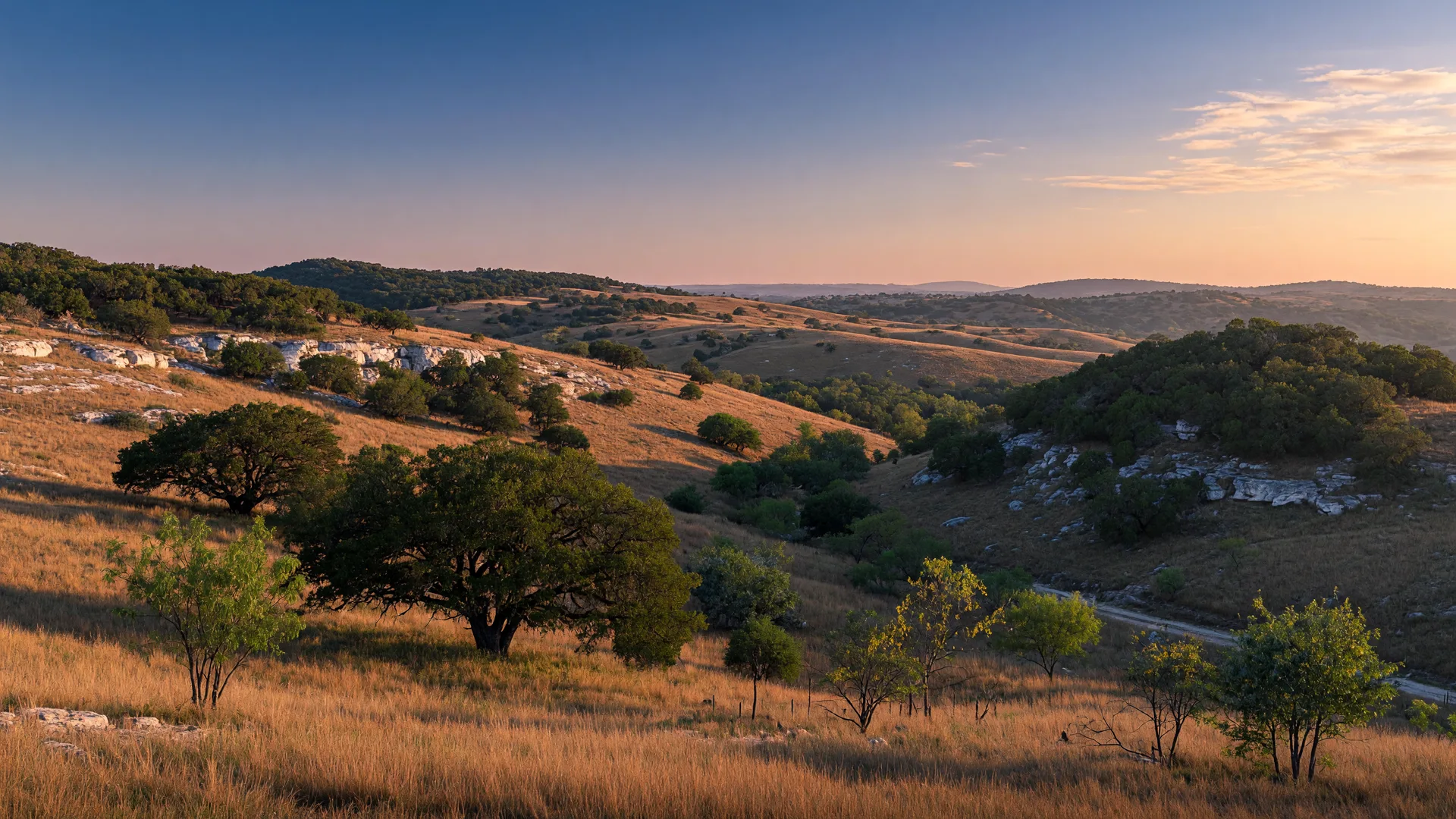
The terrain is best described as rolling to hilly. Elevation in the Boerne area ranges from approximately 1,100 to 2,300 feet above sea level, with Boerne itself sitting at roughly 1,400 to 1,525 feet. The hills are not dramatic by California standards — there are no 4,000-foot peaks or dramatic canyon walls. What you get instead is a continuous, undulating landscape of rounded limestone ridges, shallow valleys, and cedar-covered slopes. The effect, especially in spring when the grass is green and the wildflowers are blooming, is quietly attractive rather than visually overwhelming.
The limestone also affects practical things. Well water in the Hill Country is filtered through limestone, which gives it a distinctive mineral character. Limestone soils are thin and alkaline — they drain quickly and do not hold moisture the way clay soils do, which affects landscaping, gardening, and how water behaves on the property. During heavy rains, the impervious limestone bedrock can cause rapid runoff into creeks and low-lying areas. This is one of the reasons flash flooding is a real concern in parts of the Hill Country, and why properties in flood-prone areas carry flood insurance requirements that California buyers are not always expecting.
The Climate: Subtropical with Real Seasons
The Hill Country climate is classified as subtropical subhumid. For California relocators, the most important thing to understand is that this is not a Mediterranean climate. California's coastal regions have dry summers and wet winters. The Hill Country does the opposite — summers are the wettest season, and winters are the driest. This reversal matters for landscaping, water planning, and how you experience the year.
Average annual rainfall in the Boerne area is approximately 32 to 38 inches, which is comparable to parts of the Bay Area but distributed differently. Most of the rain falls between April and October, with peak rainfall in May, June, and September. The summer thunderstorms can be intense — short, heavy downpours that drop one to two inches in an hour. These storms are localized and usually pass within 30 to 60 minutes. They are not the all-day rains that California gets in winter.
Winters are mild. Average highs in January and February are in the low to mid-60s, with overnight lows in the mid-30s to low 40s. Snow is rare — a light dusting might happen once every few years, and it usually melts by midday. The growing season averages approximately 231 days, which is substantially longer than any California climate zone except the desert lowlands and parts of the Central Valley.
Monthly Climate at a Glance: Boerne, Texas
The table below provides monthly averages for Boerne. These are approximate values based on climate data for Kendall County and the surrounding Hill Country.
| Month | Avg High | Avg Low | Rainfall (in.) | What It Feels Like |
|---|---|---|---|---|
| January | 62°F | 36°F | 1.5 | Cool and dry. Light jacket weather. Occasional hard freeze. |
| February | 65°F | 39°F | 1.8 | Warming slightly. Still dry. Hill Country starts to green up late in the month. |
| March | 72°F | 46°F | 2.2 | Wildflower season begins. Bluebonnets appear along roadsides. Comfortable days, cool nights. |
| April | 79°F | 53°F | 2.8 | Peak wildflower season. Hill Country at its most visually striking. Thunderstorm season begins. |
| May | 84°F | 61°F | 4.0 | Warm. Rainiest spring month. Grass is at its greenest. Spring storms roll through regularly. |
| June | 90°F | 68°F | 4.2 | Summer heat begins. Afternoon thunderstorms common. Humidity rises noticeably. |
| July | 94°F | 71°F | 2.5 | Peak heat. Sustained days above 95°F. Afternoon storms less frequent but intense when they arrive. |
| August | 95°F | 71°F | 2.3 | Hottest month. Grass turns golden-brown. Creek levels drop. Live oaks remain green. |
| September | 89°F | 66°F | 3.8 | Transition month. Temperatures ease. Second wettest month. Relief from summer heat arrives gradually. |
| October | 81°F | 56°F | 3.0 | Best weather of the year. Warm days, cool nights, low humidity. Outdoor season peaks. |
| November | 71°F | 45°F | 2.0 | Cool and pleasant. Football weather. Hill Country oaks may drop leaves briefly. |
| December | 64°F | 37°F | 1.5 | Mild and dry. Shortest days. Live oaks are evergreen — the landscape stays green even in winter. |
Averages based on Boerne and Kendall County climate data. Actual conditions vary by elevation and microclimate. Source: Climate-Data.org, NOAA, Texas Almanac.
What the Seasons Actually Look Like
California relocators are accustomed to a landscape that looks largely the same year-round — the oaks stay green, the grass turns brown in summer, and the hills stay brown until the first winter rains. The Hill Country follows a different visual calendar.
Spring (March through May)
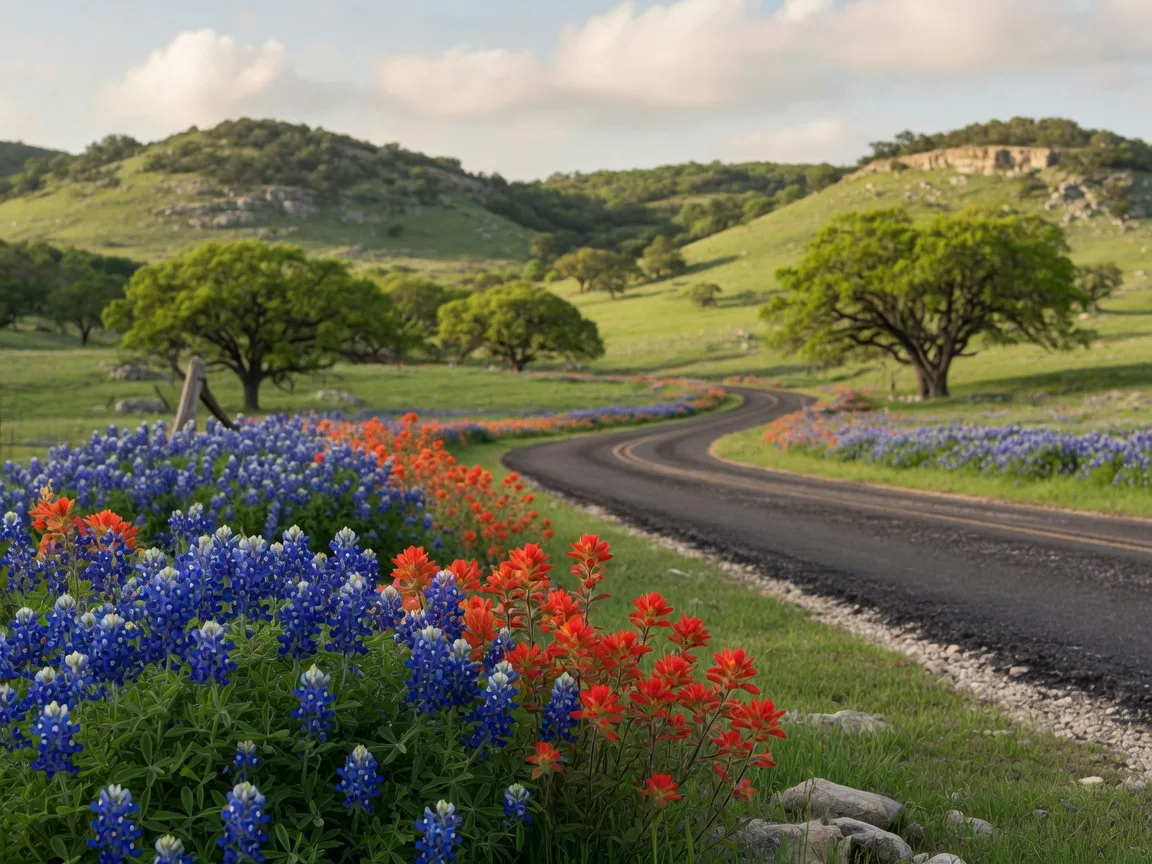
Spring is the Hill Country at its most photogenic. Bluebonnets begin appearing along roadsides in late March, reaching peak bloom in early to mid-April. Indian paintbrush, black-eyed Susans, and dozens of other wildflower species follow. The hills, which have been muted brown and gray through winter, turn vivid green. This is the season that surprises California transplants — the Hill Country in spring is genuinely, strikingly beautiful.
Spring is also when the landscape is most alive with water. Cibolo Creek and the Guadalupe River run at their highest levels. Wildflower season coincides with the beginning of thunderstorm season, so afternoon rain is common. The combination of warm days, green hills, wildflowers, and regular storms creates a sense of renewal that residents describe as one of the best parts of living here.
Summer (June through August)
Summer is the most challenging season for California transplants. Temperatures regularly exceed 95°F from June through August, and 100°F days are common in July and August. Humidity is noticeably higher than California's dry inland valleys — the air feels heavier, particularly in the mornings and evenings. This is a genuine adjustment for people from the Bay Area, Sacramento, or coastal Southern California.
The landscape changes visibly during summer. The grass that was bright green in April and May turns golden-brown by mid-June and stays that way through September. This is normal — the native grasses are adapted to this cycle, and it is not a sign of drought or neglect. The live oaks, however, remain dark green year-round. Live oaks are the dominant tree in the Hill Country, and their evergreen canopy is what keeps the landscape from looking barren in summer. The contrast between the golden grass and the dark oaks is the defining visual of a Hill Country summer.
Creek levels drop. The Guadalupe River remains swimmable, but smaller creeks may dry to a trickle or go dry entirely. This is expected behavior, not an emergency. The creeks recharge when the fall rains return.
Fall (September through November)
Fall is the season most residents describe as their favorite. The heat breaks gradually through September and October, with daytime highs dropping into the low 80s by mid-October. Humidity decreases. The grass starts to green up again in October as fall rains arrive. The air is clearer, the sky is bluer, and the light takes on the warm, golden quality that makes Hill Country photography distinctive.
Fall is also when the landscape is at its most functional for outdoor life. Hiking, cycling, kayaking, and general outdoor activity are all more pleasant in the fall than in any other season. The state parks, which may be uncomfortable in midsummer, are ideal from October through November.
Winter (December through February)
Winter in the Hill Country is mild by most national standards, but it is not California-mild. Daytime highs average in the low to mid-60s, with overnight lows in the mid-30s. Freezes are possible — typically a few per winter, with occasional hard freezes that bring temperatures into the low 20s. These hard freezes are infrequent but real, and they affect landscaping, plumbing (especially exposed pipes), and the occasional lost garden season.
The Hill Country landscape in winter is defined by the live oaks. Because live oaks are evergreen, the tree canopy stays dark green even when deciduous trees have lost their leaves. The visual effect is a landscape that looks alive in winter — not lush, but present. It is a different kind of winter beauty than what you see in California's oak woodlands, where the deciduous valley oaks are bare by December.
"The Hill Country in spring is the landscape that sells people on the move. The golden hills in summer are the landscape they have to learn to appreciate. Both are real, and both are part of living here."
The Vegetation: Live Oaks, Cedar, and Native Grass
Understanding Hill Country vegetation is important for California relocators because it affects what your property looks like, how you maintain it, and what you can expect to grow.
Live Oaks
Live oaks are the signature tree of the Hill Country. They are evergreen — keeping their leaves year-round — and they grow in wide, spreading canopies that provide substantial shade. A mature live oak can reach 40 to 60 feet tall with a canopy spread of 60 to 80 feet. They are drought-tolerant once established, and they thrive in the thin limestone soils that characterize the region. Live oaks are protected by city ordinances in many Hill Country communities, including Boerne, where removal of heritage trees typically requires a permit. For California relocators, the key difference from California oaks is that live oaks are evergreen — they do not go dormant in winter, and they do not lose their leaves in a single dramatic drop. Instead, they replace leaves gradually throughout the year.
Ashe Juniper (Cedar)
Ashe juniper, locally called "cedar," is the other dominant woody plant in the Hill Country. It is an evergreen conifer that grows densely on limestone hillsides, often forming thick stands called cedar brakes. Cedar is ecologically important — it provides habitat for the endangered golden-cheeked warbler, a migratory songbird that nests exclusively in mature Ashe juniper bark in central Texas. From a landscaping perspective, cedar is polarizing. It consumes significant groundwater, produces copious pollen in late winter (February and March), and is highly flammable. Many Hill Country landowners manage cedar through selective clearing to reduce fire risk, improve water absorption, and open views. If you are buying property with significant cedar cover, understand that management is an ongoing part of Hill Country land stewardship.
Native Grasses
The Hill Country's native grasses are adapted to the region's wet-summer, dry-winter climate cycle. Species like little bluestem, sideoats grama, and buffalo grass turn golden-brown in summer and green up in fall and spring. This seasonal color change is natural and expected. California transplants sometimes mistake summer-brown grass for dead or neglected landscaping. It is neither — it is the natural state of native Hill Country grasses during the dry season. Maintaining a green lawn through summer requires supplemental irrigation, which is a cost and resource consideration that many new residents weigh carefully.
Water in the Landscape: Creeks, Springs, and the Edwards Aquifer
Water defines the Hill Country in ways that go beyond aesthetics. The region sits atop the Edwards Aquifer — one of the most productive artesian aquifers in the world — and the network of springs, creeks, and rivers that flow from it are central to the landscape and the community's water supply.
Cibolo Creek runs through the center of Boerne, and it is the defining natural feature of the town. The creek flows year-round in most stretches, fed by springs in the upstream watershed. Its clarity varies with rainfall — clear and shallow in dry periods, turbid and higher after storms. The creek is a recreational and aesthetic asset: walking trails follow it through downtown, restaurants and homes face it, and the Cibolo Nature Center sits along its banks.
The Guadalupe River, about 30 to 35 minutes east of Boerne, is the region's primary recreational waterway. It runs clear and cold in its upper reaches, spring-fed by the Edwards and Trinity aquifers. Tubing, kayaking, swimming, and fishing are regular activities from May through September. The river is also the source of the Canyon Lake reservoir, which provides water supply and flood control for the region.
For California relocators, the water situation in the Hill Country is worth understanding in practical terms. Many Hill Country properties outside municipal water systems rely on private wells drawing from the Edwards or Trinity aquifers. Water quality and availability vary by location, depth, and aquifer conditions. Municipal water in Boerne and surrounding communities is sourced from the aquifer and surface water, treated, and distributed through the municipal system. Water rates in the Hill Country are generally lower than California water rates but are trending upward as the population grows.
How the Hill Country Landscape Compares to California
The honest comparison between the Hill Country and California landscapes is that they are fundamentally different, and neither is objectively better. Each has strengths that appeal to different priorities.
What the Hill Country does not have
- Ocean or significant coastline. The nearest coast is Corpus Christi, roughly three hours south. This is the single biggest landscape difference for California relocators.
- High mountains. The Hill Country peaks at around 2,300 feet in the Boerne area. There is no alpine terrain, no snow-capped peaks, and no mountain skiing within driving distance.
- Evergreen mountain forests. The Hill Country does not have redwood forests, giant sequoias, or the dense conifer forests of the Sierra Nevada. The tree canopy is dominated by live oaks and juniper, which are green but shorter and more open.
- Dramatic elevation changes. The terrain rolls rather than peaks. If you are used to the visual drama of Big Sur, Yosemite, or the coastal escarpment, the Hill Country will feel comparatively subdued.
- Mediterranean climate. The wet-summer pattern is the opposite of California's. If you are accustomed to dry, predictable summers, the Hill Country's humid, storm-prone summers will require adjustment.
What the Hill Country does have
- Genuinely green winters. Because live oaks are evergreen, the Hill Country stays visually alive through winter. There is no bare-tree season.
- Spring wildflower displays. The Hill Country's wildflower season is more concentrated and visually dramatic than anything in coastal California. The bluebonnet bloom in April is a legitimate natural event.
- Spring-fed water features. The creeks, rivers, and springs in the Hill Country are clearer and more accessible than most California waterways. Swimming in a spring-fed Hill Country creek is a different experience than anything in the Bay Area.
- Less crowded outdoor spaces. The state parks and natural areas near Boerne and San Antonio are significantly less crowded than their California equivalents, even during peak season.
- Lower maintenance outdoor living. The native landscape requires less water, less mowing, and less intervention than a California lawn. Many Hill Country homeowners work with the natural landscape rather than against it.
Landscape Distances: How Far to Different Terrain
One advantage of living in the Hill Country is proximity to varied terrain. From Boerne or Fair Oaks Ranch, a range of landscapes are within a day-trip drive.
| Destination | Drive from Boerne | What You Will Find |
|---|---|---|
| Guadalupe River | 30–35 min | Spring-fed river, swimming, tubing, kayaking |
| Enchanted Rock | 55–65 min | Massive granite dome, summit hike, stargazing |
| Canyon Lake | 25–35 min | Reservoir with boat ramps, swimming, fishing |
| San Antonio River Walk | 30–40 min | Urban river corridor, dining, cultural venues |
| Texas Coast (Corpus Christi) | 3–3.5 hours | Gulf of Mexico beaches, fishing, bay kayaking |
| West Texas (Big Bend) | 6–7 hours | Desert mountains, canyon landscapes, dark-sky stargazing |
Practical Implications of the Landscape
The Hill Country landscape affects day-to-day life in ways that are worth understanding before you buy.
Landscaping
Most Hill Country properties use a mix of native plants, adapted ornamentals, and limited turf grass. Maintaining a full green lawn through summer requires significant irrigation, which increases water bills and places strain on well systems or municipal supply. Many homeowners transition to native plant landscaping — Texas sage, mountain laurel, autumn sage, and native grasses — that requires less water and aligns with the regional climate. This is not a compromise; it is how the landscape is designed to work.
Outdoor Living
The Hill Country climate supports year-round outdoor living, but the timing matters. Spring (March through May) and fall (September through November) are the seasons when outdoor spaces are used most intensively. Summer outdoor living typically happens in the morning before 10 AM or in the evening after 6 PM, with shaded patios and misting systems providing relief during peak heat. Winter outdoor living is comfortable during daytime hours — a patio lunch in December is pleasant when the sun is out and the temperature is in the 60s.
Property Characteristics
Hill Country properties frequently feature limestone outcroppings, native tree cover, sloped terrain, and natural drainage patterns. These characteristics affect construction, grading, driveway design, and septic system placement. A flat, rectangular California suburban lot and a sloped, tree-covered Hill Country parcel are fundamentally different canvases. Working with a builder or contractor who understands Hill Country construction — including limestone foundations, cedar management, and drainage engineering — is worth the effort.
Wildlife
The Hill Country supports a significant wildlife population that you will encounter regularly. White-tailed deer are common in every Hill Country community — they browse on landscaping, cross roads at dawn and dusk, and are a visible part of daily life. Wild turkeys, roadrunners, and a variety of songbirds are frequent visitors to residential areas. Less welcome visitors include fire ants (ubiquitous in the soil), scorpions (present but not dominant), and copperheads and western diamondback rattlesnakes (present in natural areas and occasionally in residential yards near undeveloped land). Standard precautions — watching where you step, checking shoes left outside, keeping landscaping trimmed near the house — are part of living in the region.
"The landscape is not the reason most people move to the Hill Country. Schools, cost of living, and no state income tax drive the decision. But the landscape is often the reason people stay. The wildflowers in April, the creek running through downtown, the live oaks framing the sunset — those are the things that make a house feel like a home."
The Landscape as a Quality-of-Life Factor
The Texas Hill Country landscape is different from California's, and pretending otherwise would be dishonest. It does not have the Pacific Ocean, the Sierra Nevada, or the Mediterranean climate. What it does have is a distinctive, well-defined landscape of limestone hills, live oak woodlands, spring-fed creeks, and seasonal wildflowers that most people learn to value once they have lived through a full year in it.
The practical advice for California relocators is this: visit the Hill Country during two different seasons if you can. A spring visit will show you the landscape at its best. A midsummer visit will show you the reality of August heat and golden-brown grass. Both are true. Both are part of living here. Understanding the full picture — not just the highlight reel — is how you make a decision you will not second-guess.
For a broader comparison of Hill Country communities, see the city comparison guide. For a detailed breakdown of housing costs and property taxes, review the cost of living comparison. And for the practical logistics of making the move, the relocation checklist covers the 90-day timeline from listing your California home to closing in Texas.

Written by
Bill Ross
Hill Country Homesteads Group, brokered by KW Boerne
Bill Ross is a Texas real estate agent with nearly four decades in high-tech sales and a network of 1,000+ California real estate agents for coordinated cross-state transactions. Recognized in USA Today and The Washington Post for his relocation expertise.
Related Guides
Boerne vs Fair Oaks Ranch vs San Antonio
Compare Hill Country communities for families, retirees, and remote workers.
California to Texas Cost of Living
Housing, taxes, insurance, utilities, and daily expenses side by side.
State and Local Parks Near Boerne
Enchanted Rock, Guadalupe River, Government Canyon, and more.
What Californians Miss After Moving
An honest look at what changes — and what you gain — in the move.
Sources
- Boerne and Kendall County climate data — temperature, rainfall, elevation — Climate-Data.org, Boerne climate page; Texas Almanac, Kendall County entry. climate-data.org
- Edwards Plateau geology and Hill Country terrain — Texas Parks and Wildlife Department, Hill Country region overview. tpwd.texas.gov
- Boerne elevation data — Elevation.city; WorldAtlas, Boerne, Texas. worldatlas.com
- Hill Country vegetation, native plants, and landscaping — Native Plant Society of Texas, Boerne Chapter; Hill Country Master Gardeners. npsot.org; hillcountrymastergardeners.org
- Edwards Aquifer and regional water supply — Edwards Aquifer Authority. edwardsaquifer.org
- Ashe juniper and golden-cheeked warbler habitat — U.S. Fish and Wildlife Service; Texas Parks and Wildlife Department.
- Kendall County growing season and climate norms — NOAA National Centers for Environmental Information; Texas Almanac.
Last reviewed: July 2026. Climate data and geographic details verified against current sources.