
If you're relocating from California to Texas and buying a home here, the closing process will feel unfamiliar — not because it's more complicated, but because it works differently than you're used to. That difference matters. Understanding it before you sign your first contract keeps you from signing documents you don't understand, paying for things you didn't expect, or making decisions under deadline pressure.
Here's what you need to know.
What You're Used To in California
In California, real estate transactions typically involve four separate parties playing distinct roles: the buyer's agent, the seller's agent, a separate escrow officer, and often a real estate attorney.
The escrow officer works for an escrow company (sometimes affiliated with the title company, sometimes independent) and serves as the neutral third party who holds earnest money, coordinates document signing, communicates between buyer and seller, and manages the flow of funds through closing. In many California markets, real estate attorneys review contracts, advise on contingencies, and may attend closing — particularly in higher-value transactions.
Title insurance exists in California, but the market is less regulated. Premiums are negotiated between title companies, which means rates can vary and shopping around is common.
The process takes weeks of back-and-forth, and the closing itself often involves multiple appointments: one to sign, one to fund, and a gap between them.
Texas doesn't work that way.
Texas Uses Promulgated Title Policies
In Texas, the Texas Department of Insurance (TDI) sets the rates for owner's title insurance policies. These are called promulgated policies — meaning the state determines the premium based on a standardized rate schedule, and every title company in Texas must charge that same rate.
This eliminates the price-shopping that's normal in California. You won't save money by calling five title companies to compare rates on the policy itself. What you can shop is the closing fee (sometimes called the settlement fee) and any ancillary charges — but the bulk of the title insurance premium is fixed by regulation.
The policy itself is comprehensive. The standard T-1 policy in Texas covers defects in title that existed before you closed — including forged documents, undisclosed heirs, errors in the public record, and claims that surface after you've bought the home. It's a one-time premium paid at closing, and it protects you for as long as you own the property.
This system exists because Texas has a long history of title disputes tied to land grants, mineral rights, and surveying errors that predate statehood. The promulgated policy structure was designed to standardize coverage and prevent title companies from offering inadequate or inconsistent protection.
The T-19.1 Survey Amendment: The "Good Neighbor" Endorsement
A standard Texas T-1 title policy provides broad coverage — but it explicitly excludes coverage for boundary shortages, encroachments, and overlapping fences. If your neighbor's garage extends three feet onto your property, or a fence was built across the recorded lot line decades ago, the standard policy won't protect you.
The T-19.1 endorsement closes that gap. It covers structural encroachments, boundary line disputes, and survey matters that a standard physical survey might miss — or that a previous survey didn't catch because fences and structures moved over time.
Here's how to get it: under Paragraph 6A(8) of the TREC One to Four Family Residential Contract (Resale), the contract defaults to stating that the standard title commitment "will not be amended" to include the T-19.1 coverage. Buyers should change that language to "will be amended" at closing — a simple checkbox change during contract negotiation. For a nominal regulatory fee (typically 5% or 10% of the basic title premium), the title company adds the T-19.1 endorsement to your owner's policy.
For a buyer relocating from California — where boundary disputes may not be top of mind because lot lines in suburban tracts are rarely ambiguous — the T-19.1 is cheap insurance against a problem that's more common in Texas Hill Country properties, where acreage, older fences, and irregular lot shapes create genuine uncertainty about where one property ends and the next begins.
Given that the endorsement costs a fraction of the title premium and protects against a problem that can cost tens of thousands to litigate, most California buyers should request it. It's a line item worth checking in Paragraph 6A(8) before you sign.
The Title Company Handles Closing
In Texas, there is no separate escrow officer. The title company performs that function as part of its role in the transaction.
Here's what that means in practice:
The title company holds your earnest money deposit in escrow once you execute the contract. They conduct the title search to identify any liens, judgments, unpaid taxes, or ownership claims that cloud the title. They prepare the closing documents — the deed, the settlement statement, the disclosures. They coordinate the signing appointment with both buyer and seller (though in Texas, these appointments are often held separately). They disburse funds to the seller, the lender, the agents, and any lienholders. They record the deed with the county clerk after closing.
The same entity is managing the entire transaction from contract execution through recording. There's no handoff between an escrow company and a title company. There's no neutral third party separate from the title insurer.
For California buyers, this consolidation can feel strange at first. You're used to multiple checkpoints and multiple parties each responsible for different pieces. In Texas, the title company is the central point of coordination, and your primary contact throughout the closing process will be the title officer or closer assigned to your file.
No Attorney Requirement in Most Transactions
Texas does not require buyers or sellers to have a real estate attorney present at closing, or even involved in the transaction at all. Most residential purchases in Texas — the vast majority — close without an attorney in the room.
This is a significant cultural difference from California, where attorney involvement is common in higher-value transactions and expected when complications arise.
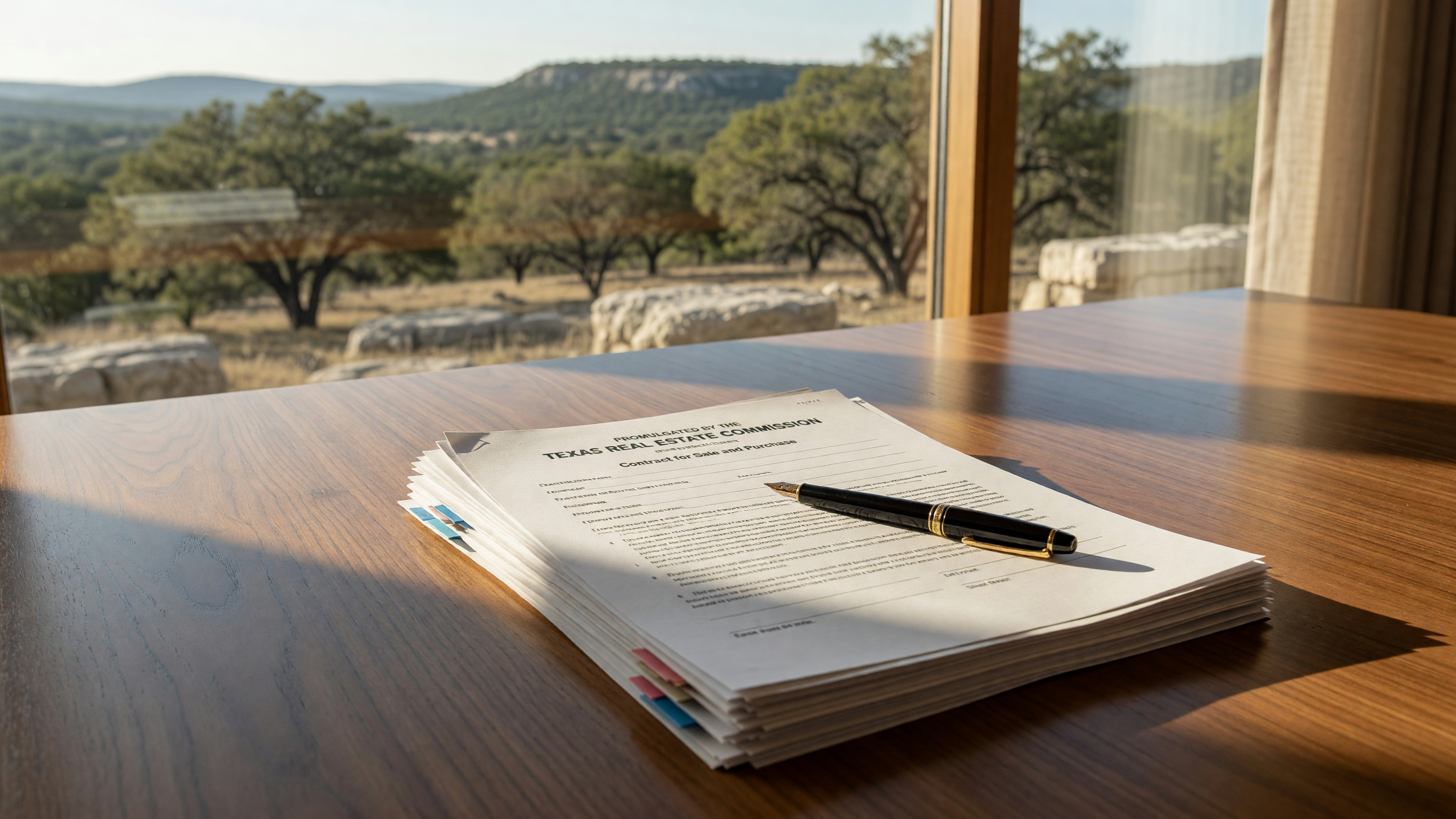
In Texas, the contract forms used in most residential transactions are promulgated by the Texas Real Estate Commission (TREC). These are standardized contracts designed to be clear enough that agents and title companies can guide buyers and sellers through them without legal counsel. The forms spell out contingencies, timelines, earnest money procedures, and default remedies in detail.
That said, the absence of an attorney requirement doesn't mean you shouldn't hire one. Complex transactions — properties with boundary disputes, mineral rights questions, easement issues, or unusual title problems — may benefit from legal review. Buyers who are uncomfortable with the process or who want a second set of eyes on documents before signing can engage an attorney independently. It's just not a structural requirement the way it is in some states or in certain California markets.
The Texas Closing Process, Step by Step
Here's what actually happens from contract to keys in Texas.
Week 1: Contract Execution and Title Search
Once you and the seller sign the contract, it's delivered to the title company along with your earnest money check (usually 1–2% of the purchase price). The title company opens escrow, deposits your earnest money, and begins the title search.
The title search examines the chain of ownership, identifies any existing liens or encumbrances, and flags issues that need resolution before closing. In Texas, this often turns up unpaid HOA assessments, contractor liens, divorce decrees that weren't properly recorded, or tax liens from years ago.
You'll receive a preliminary title report (sometimes called a title commitment) within a week or two of opening escrow. This document shows the conditions under which the title company will issue a policy — including any exceptions or requirements that must be cleared first.
Strict Delivery Rules for Earnest Money and Option Fees
California buyers are accustomed to casual timelines where earnest money is deposited days — sometimes a week or more — after escrow opens. Texas operates on strict, unforgiving deadlines, and misunderstanding them can cost you the house.
Under the modern TREC contract framework, both the Earnest Money and the Option Fee must be delivered to the title company within 3 calendar days after the contract's effective date. If the third day falls on a Saturday, Sunday, or legal holiday, the deadline extends to the next business day. But there is no other grace period, and there is no "close enough" standard.
If a buyer misses this deadline — by even one minute — two consequences follow immediately. First, the seller can unilaterally terminate the contract. Second, if the seller does not terminate but the buyer has not yet paid the option fee, the buyer loses their unrestricted right to terminate under the option period. The contract doesn't pause or wait for a late payment. Under the current TREC One to Four Family Residential Contract (Resale), both the earnest money and option fee delivery deadlines are consolidated in Paragraph 5. The contract states plainly that each must be delivered to the title company within 3 calendar days of the effective date — a single paragraph now governs what older TREC contract versions split across separate paragraphs. (In prior form iterations, earnest money and option fee deadlines appeared in distinct paragraphs, so references that cite different paragraph numbers may be pointing to an outdated version.) These deadlines are structural, not aspirational.
For buyers moving from California, the practical implications are real: you're often wiring earnest money from a California bank to a Texas title company's escrow account, which can add a day or two of processing time. Don't wait until day three to initiate the transfer. Wire the funds immediately after execution, or hand-deliver a cashier's check to the title company's office. Personal checks are accepted for the initial earnest money and option fee deposit — Texas title companies routinely accept them in the first 3 days after contract execution — but they are strictly banned for final closing-day funds under the "Good Funds" rules discussed below.
Week 2–3: Contingency Periods
Texas contracts include several standard contingency periods that run in parallel:
Option period: Texas contracts include an unrestricted right to terminate for a negotiated number of days (usually 7–10) in exchange for a nominal fee (typically $100–$500). During this time, you can terminate for any reason — or no reason — and get your earnest money back minus the option fee. This is unique to Texas and California doesn't have an equivalent provision.
Inspection period: You hire a licensed inspector to examine the property. The standard Texas inspection contingency gives you the right to request repairs or terminate based on inspection findings. The timeline is negotiable but typically runs 7–14 days.
Appraisal and financing contingencies: If you're getting a mortgage, these run concurrently. The appraisal must come in at or above the purchase price, and your lender must approve the loan under the terms specified in the contract.
Week 3–4: Clearing Title Issues
If the title search identified problems — unpaid liens, missing signatures, unrecorded releases — the seller (or the seller's title company) must resolve them before closing. This can involve paying off old debts, obtaining signatures from ex-spouses or deceased owners' heirs, or correcting errors in the public record.
This is where transactions can stall. A title issue that seems minor on the surface — a divorce decree that wasn't filed, a lien from a contractor who went out of business, a boundary survey from 1950 that contradicts the current legal description — can take weeks to untangle. California buyers aren't used to this because the title search in California often completes faster and identifies fewer issues.
In Texas, the title company will tell you what needs to be cleared and provide a timeline. If it can't be resolved before your closing date, you may need to extend — which requires agreement from both parties.
Many title commitments also include exceptions for matters that an accurate survey would reveal — encroachments, easements, boundary discrepancies, and the like. Obtaining a current survey (often required by lenders anyway) and requesting the appropriate endorsement can remove or limit these exceptions, providing stronger protection. Discuss survey requirements and costs early with your title company.
Week 4–5: The Closing Disclosure
Your lender is required to provide a Closing Disclosure at least three business days before closing. This document shows the final loan terms, projected monthly payments, and a line-by-line accounting of closing costs.
Review this carefully. Compare it to the Loan Estimate you received at application. If anything has changed — the interest rate, the closing costs, the cash needed to close — ask questions immediately. Lenders are required to explain changes, and you have the right to a three-day review period before proceeding.
In Texas, the closing disclosure also breaks down the title insurance premium, the settlement fee, and any other title-related charges. Because the title policy is promulgated, the premium itself shouldn't change from what was originally quoted — but the settlement fee and ancillary charges might.
Closing Day: The Signing Appointment
Closing in Texas typically happens at the title company's office, though mobile closers can meet you elsewhere if needed. The appointment takes 45–90 minutes.
You'll sign a stack of documents: the deed of trust (if financing), the promissory note, the settlement statement, various disclosures, and any lender-required paperwork. The title closer will explain each document as you sign, though they cannot provide legal advice.
In Texas, buyer and seller often sign separately — sometimes on the same day, sometimes a day apart. The transaction doesn't fund until both parties have signed and the lender has approved the final documents.
Funding and Recording
Once the lender receives the signed documents and approves them, they wire the loan funds to the title company. The title company verifies receipt of the lender's funds — this is what "funded" means. At that point, the transaction is funded, and possession legally transfers to the buyer under TREC Paragraph 10: "Possession shall be delivered to Buyer upon Closing and Funding."
Why does Texas funding happen so cleanly on closing day — with no gap between signing and funding, and no waiting for checks to clear? The answer is the Texas Insurance Code's "Good Funds" Law. This statutory rule dictates that a title company cannot disburse keys or money until all incoming funds — lender wires and the buyer's cash-to-close — are officially settled and deposited. Because wires settle same-day and cashier's checks represent guaranteed funds, title companies can verify final receipt within hours of the signing appointment and fund the transaction immediately. Personal checks and standard ACH transfers, by contrast, can take several business days to settle, so title companies strictly reject them on closing day — they cannot legally disburse against uncollected funds.
For California buyers, this explains a practical reality you'll encounter: bring a cashier's check or arrange a wire transfer for your cash-to-close, and don't expect to write a personal check at the closing table. It won't be accepted. The rule isn't the title company being difficult — it's a statutory requirement designed to ensure that when the money moves, it has actually arrived.
The title company does not wait for county recording to be finalized before releasing keys. Recording the deed with the county clerk happens after funding — sometimes the same day, sometimes the next day, and in counties with recording backlogs it can take several days. But the keys are handed over at funding, not at recording. Title companies only require the lender's funds to be fully disbursed; they do not make possession contingent on the county clerk confirming the deed is on file.
This is an important distinction for California buyers: in some California transactions, possession is tied to recording confirmation, which can mean an extra 24–48 hours of waiting. In Texas, funding is the trigger — once the money moves, the house is yours. In busy counties like Bexar or Kendall, waiting for formal recording confirmation would delay possession unnecessarily, and no one in a standard Texas transaction does that.
Verify wire instructions directly. Never rely on email alone.
Real estate wire fraud is common. Never rely solely on emailed wire instructions — scammers can compromise email accounts and send fraudulent wiring details that look legitimate. Call your title company using a phone number you independently verify (from their website or prior legitimate correspondence) to confirm any wiring details or changes before you send funds. The title company will never ask you to send funds to a new account via email alone, and they will never pressure you to wire money without verification.
Who Pays What: Texas Closing Costs
Closing costs in Texas are structured differently than in California, and the allocation is often negotiated in the contract rather than dictated by custom. But before we get to the line items, the biggest structural difference — the one that shapes everything else — is that Texas consolidates the closing into a single entity. In California, the escrow company and the title company are separate, independent operations. In Texas, those roles merge into the title company alone. The table below maps out every consequential difference that flows from that structural split.
| Aspect | California Escrow Process | Texas Title Process |
|---|---|---|
| Who handles the closing | A licensed escrow officer — a neutral third party separate from the title company — holds funds, coordinates documents, and manages communication between buyer and seller. | The title company. A single title officer manages earnest money escrow, the title search, document preparation, signing coordination, fund disbursement, and deed recording. No separate escrow officer exists. |
| Who pays for owner's title policy | Negotiable but frequently the buyer. Premiums are market-priced — title companies compete on rate, and shopping around is standard practice. | Explicitly negotiated via a checkbox in TREC Paragraph 6A. By widespread Texas custom the seller often pays, but it is a contract term, not a default. Premium is state-regulated (promulgated rate) — every title company charges the same price for the same coverage. |
| Who pays for lender's title policy | Buyer. Required by the mortgage lender. | Buyer. Required by the mortgage lender. Same as California. |
| Earnest money handling | Held by the escrow company in a trust account. Deposit timelines are often flexible — days or even a week after escrow opens is common. Personal checks are typically accepted. | Held by the title company in escrow. Strict 3-calendar-day delivery deadline from contract effective date. Late deposit gives the seller the right to terminate. Personal checks are accepted for initial escrow deposits, but strictly banned for final closing day funds. |
| Unrestricted termination right | No direct equivalent. California buyers rely on multiple separate contingencies (inspection, appraisal, loan) — each with its own terms and cure periods — and there is no contractual right to walk away without cause stated. | The option period — a feature unique to Texas. A paid, unrestricted right to terminate for any reason or no reason during a negotiated window (typically 7–10 days), for a nominal fee ($100–$500). Earnest money is returned; the option fee is kept by the seller. |
| Attorney involvement | Common in higher-value transactions and expected when complications arise. Attorneys frequently review contracts and may attend closing. | Not required. The vast majority of residential transactions close without an attorney. TREC-promulgated contract forms are designed for agent-guided use. Buyers may hire counsel independently for complex transactions. |
| Typical timeline | 30–45 days for financed purchases. Signing and funding are often separate events with a gap of 1–2 days between them. Possession may be tied to recording confirmation, adding further delay. | 30–45 days for financed purchases. Signing, funding, and key release all happen the same day — possession transfers at funding per TREC Paragraph 10, not at recording. Cash purchases can close in as little as 10–14 days. |
With that structural framework in mind, here is how the line-item closing costs typically land:
Buyer typically pays:
- Lender's title policy (if financing)
- Closing/settlement fee (often split with seller)
- Appraisal fee
- Inspection fees
- Loan origination and underwriting fees
- Prepaid items (property taxes, insurance, interest)
- Survey fee (if required)
Seller typically pays:
- Owner's title insurance premium (see note below)
- Real estate agent commissions (both sides)
- Closing/settlement fee (often split with buyer)
- Outstanding liens or judgments
- Unpaid property taxes (prorated to closing date)
- HOA transfer fees and unpaid assessments
Important: Who pays the owner's title policy is a contract choice
Under the standard TREC One to Four Family Residential Contract, Paragraph 6A provides an explicit checkbox choice for whether the Buyer or Seller pays the Owner's Title Policy premium. It is not a fixed allocation. By widespread local custom across most Texas markets, however, the Seller frequently pays for the owner's policy — a convention that has developed precisely because the contract places the decision on the table. The buyer typically pays for the lender's title policy (required by the mortgage lender), but the owner's policy is routinely negotiated as part of the contract terms. Don't assume you're on the hook for it, and don't let anyone tell you the buyer always pays. Read Paragraph 6A of your contract — the checkbox tells you what you actually agreed to.
Total closing costs for buyers in Texas typically range from 2–5% of the purchase price, excluding the down payment. On a $400,000 home, that's $8,000 to $20,000 — and the title insurance premium is often the single largest line item.
As of rates effective March 1, 2026, the basic premium for a $400,000 owner's title policy (T-1) is approximately $2,262. The lender's policy (if financing) is significantly less, often a few hundred dollars. Always confirm the exact figure with your title company using the TDI Title Rate Calculator, as ancillary fees (settlement/escrow, tax certificates, recording, etc.) are not fixed and can be negotiated or shopped.
Timeline: How Long Does Closing Take?
Most Texas closings take 30–45 days from contract execution to recording, assuming conventional financing and no major title issues.
Cash purchases can close in 10–14 days because there's no lender approval process, no appraisal requirement, and fewer contingencies.
FHA and VA loans often take 45–60 days because of additional underwriting and appraisal requirements.
Title issues can extend the timeline significantly. If the title search uncovers a problem that requires research, missing signatures, or legal filings to resolve, the closing may be delayed by weeks. In some cases — a boundary dispute, a mineral rights question, an heir who can't be located — the transaction may fall apart entirely if the issue can't be cleared within the contract timeline.
This is less common in California, where title issues are often resolved more quickly and where the escrow company may have more resources dedicated to clearing them.
For a complete cross-state timeline, see the 90-day relocation checklist and the guide to coordinating a California sale with a Texas purchase.
Common Surprises for California Buyers
The option period exists and you should use it
The Texas option period is one of the strongest buyer protections in any state. For a nominal fee, you get 7–10 days to do whatever due diligence you want — inspection, appraisal, financing — and you can walk away for any reason. California buyers sometimes skip this or minimize it because they're used to multiple separate contingencies. Don't. The option period is your safety net.
You can terminate without proving cause
During the option period, you don't need to justify your decision to walk away. You don't need an inspection report that shows problems. You don't need the appraisal to come in low. You can simply decide this isn't the right house and get your earnest money back (minus the option fee). This is unusual, and California buyers don't always realize how much leverage it gives them.
Title issues are common and can be expensive to fix
The title search in Texas often turns up more issues than in California — unpaid HOA liens, contractor liens, old divorce decrees, boundary survey discrepancies. Resolving these can cost the seller thousands and delay closing by weeks. If you're buying an older property or one that's changed hands multiple times, expect some friction in the title process.
Mineral rights are frequently severed in Texas
Many properties in the Texas Hill Country have had the mineral estate (oil, gas, and other minerals) separated from the surface rights in prior deeds. This is common and not necessarily alarming — but the standard T-1 policy typically excludes coverage for mineral reservations and related surface damage. Review Schedule B of your title commitment carefully. If minerals are important to you — or if the property is acreage — discuss with your agent and title company whether any endorsements (such as T-19.2 for limited surface damage protection) are available and worthwhile. Active leases or drilling activity should also be disclosed and evaluated during your option or inspection period.
The title company is your main point of contact
There's no escrow officer separate from the title closer. Your primary relationship during closing will be with the title company — they hold your earnest money, they conduct the search, they prepare the documents, they disburse the funds. If you're used to a three-way relationship between agent, escrow, and title, this consolidation can feel like less oversight. It's not. The title company in Texas has strong fiduciary obligations, and the promulgated policies are designed to protect you.
You don't need an attorney, but you can hire one
Most Texas transactions close without legal representation, and the TREC forms are designed to be clear. If you're uncomfortable with that — or if your transaction has complications like mineral rights, easements, or boundary disputes — you can hire an attorney to review documents or attend closing. It's just not required.
Closing is faster — and keys come at funding, not recording
Once both parties sign and the lender funds the transaction, the title company releases the keys — they do not wait for the county clerk to confirm the deed has been recorded. Funding and recording often happen the same day, but in counties with recording backlogs, recording can lag by a day or more. That doesn't delay your move-in: possession transfers at funding per TREC Paragraph 10. This is faster than California, where possession is sometimes tied to recording confirmation, creating an extra 24–48 hours of waiting. The practical result: be ready to move the moment funding hits, because the final stretch happens quickly.
Property tax proration shock: why next year's bill can be much higher than the closing estimate
At closing, the title company prorates property taxes: the seller pays through the closing date, and you assume responsibility from that point forward. The proration appears on your settlement statement, and it looks precise and final. But for California buyers, that number can be dangerously misleading — and the surprise arrives 12 months later.
Texas properties are assessed based on their status on January 1st of each year. If you buy a newly constructed home — or a home previously owned by someone with significant exemptions, such as the senior citizen tax freeze (Over-65 exemption) or the disabled veteran exemption — the closing proration will be based on that historically low, unadjusted tax amount. Maybe the prior owner was paying taxes on an assessed value of $180,000 while you just paid $500,000.
The following year, the local Central Appraisal District (CAD) — in Kendall County, Bexar County, or Comal County — reassesses the property at its full, updated market value, and those prior exemptions are removed. The buyer receives a tax bill significantly higher than what the title company estimated on the closing disclosure. For a California buyer who budgeted based on the proration figure, the gap can be thousands of dollars annually.
The fix is straightforward: calculate your future monthly payment using the local tax rate multiplied by the purchase price — not the title company's historical proration. In Kendall County, for example, multiply your purchase price by roughly 1.8–2.0% total effective rate and divide by 12. That's your realistic monthly escrow obligation after the CAD reassesses. The title company's proration is correct for what it is — a snapshot of taxes due at closing — but it is not a prediction of next year's bill. For the full breakdown, see our Prop 13 versus Texas property tax comparison.
HOA transfer fees and resale certificates
If you're buying in a community with an HOA, the seller must provide a resale certificate that discloses the HOA's financial status, any pending assessments, and the rules you'll be bound by. There's typically a fee for this certificate ($150–$375, as Texas law strictly caps this fee at $375 under Texas Property Code Section 207.003(c)), negotiated in the contract. Review the resale certificate carefully — it's your window into what you're signing up for.
The Bottom Line
Texas real estate closing is simpler, faster, and more consolidated than California's process — but simpler doesn't mean less important to understand.
The promulgated title policy protects you with standardized coverage at a regulated price. The title company manages escrow, the title search, document preparation, and disbursement — all in one place. There's no attorney requirement, but you can hire one. The option period gives you a contractual right to walk away for a nominal fee. And closing often happens 30–45 days after contract execution, with funding and recording on the same day.
The biggest mistake California buyers make is assuming the Texas process works the way they're used to. It doesn't. The differences aren't arbitrary — they reflect Texas's history of land disputes, its regulatory approach to title insurance, and its preference for streamlined transactions. Understanding those differences before you sign your first contract keeps you from surprises at the closing table.
If you're relocating to Texas and navigating this for the first time, work with a Texas-licensed agent who understands the local process, a title company with a strong track record, and — if your transaction has complications — a real estate attorney who can review what you're signing. The system works well when you understand how it works. The friction comes when you don't.
For more on avoiding the most common pitfalls, see the five mistakes California buyers make in Texas. For the complete financial picture, review the property tax comparison and the cost of living breakdown. And for step-by-step move planning, start with the 90-day relocation checklist.

Written by
Bill Ross
Hill Country Homesteads Group, brokered by KW Boerne
Bill Ross is a Texas real estate agent with nearly four decades in high-tech sales and a network of 1,000+ California real estate agents for coordinated cross-state transactions. Recognized in USA Today and The Washington Post for his relocation expertise.
Related Guides
What California Buyers Need to Know About Texas Option Periods
The paid, unrestricted right to walk away that doesn't exist in California.
Why California Buyers Underestimate Texas Property Taxes
What 1.8–2.5%+ rates really mean for your monthly payment.
How to Coordinate a California Sale and Texas Purchase
Bridge loans, dual closings, and getting the timing right across states.
90-Day Relocation Checklist
A structured timeline for every step of your cross-state move.
Sources
- Texas title insurance rates and promulgated policy structure — Texas Department of Insurance. tdi.texas.gov
- TREC contract forms and option period provisions — Texas Real Estate Commission. trec.texas.gov
- Texas closing process and title company roles — Texas State Law Library. sll.texas.gov
- California escrow and closing practices — California Department of Real Estate. dre.ca.gov
- Texas property tax proration at closing — Texas Comptroller of Public Accounts. comptroller.texas.gov
Last reviewed: June 2026. Closing procedures, fees, and title rates may vary. Consult your agent, title company, and legal counsel for guidance specific to your transaction.