
The Tax Bill Beneath
the Tax Bill
How special districts — MUDs, PIDs, ESDs, and others — can add hundreds of dollars to your monthly housing cost, whether you are buying new construction or a ten-year-old resale. Written from someone who learned it the hard way.
Range in Hill Country
Special Districts Can Add
Taxing Districts
Repayment Term
In This Guide
Five years ago, when I moved to the Texas Hill Country, I thought I understood property taxes. I'd spent nearly four decades in high-tech sales and marketing — I knew how to read a balance sheet, how to negotiate a deal, and how to do my homework before making a major decision. But nothing in my background had prepared me for what I encountered with Texas property taxing authorities.
I'd never heard of a MUD or a PID. I had no idea that the property tax rate on a listing sheet could be missing entire layers of cost. Almost every buyer relocating to the Hill Country has the same gap in their understanding, and the consequence is expensive: a tax bill that can be thousands of dollars higher than what the listing suggested.
Here's the scenario I see play out again and again. You find the right home in the Texas Hill Country — maybe it's a brand-new build in a master-planned community, or maybe it's a well-maintained ten-year-old resale in a neighborhood you love. The listing price fits your budget. The property tax estimate on the listing sheet looks manageable — maybe $6,500 a year. Everything checks out. Then you close. Months later, the first full tax bill arrives. The number is not $6,500. It is $11,200. Your monthly housing payment just jumped by $390 — and you have no idea why. Hypothetical illustration
That experience is why I wrote this article. This is everything I've learned about special taxing districts in the Texas Hill Country, written out so you don't have to go through the same discovery process I did.
What follows is a thorough explanation of what these districts are, how they work, and how to calculate their impact on your monthly payment before you sign a purchase contract. Whether you're buying brand-new construction or a resale, this is the article that saves you from an expensive surprise.
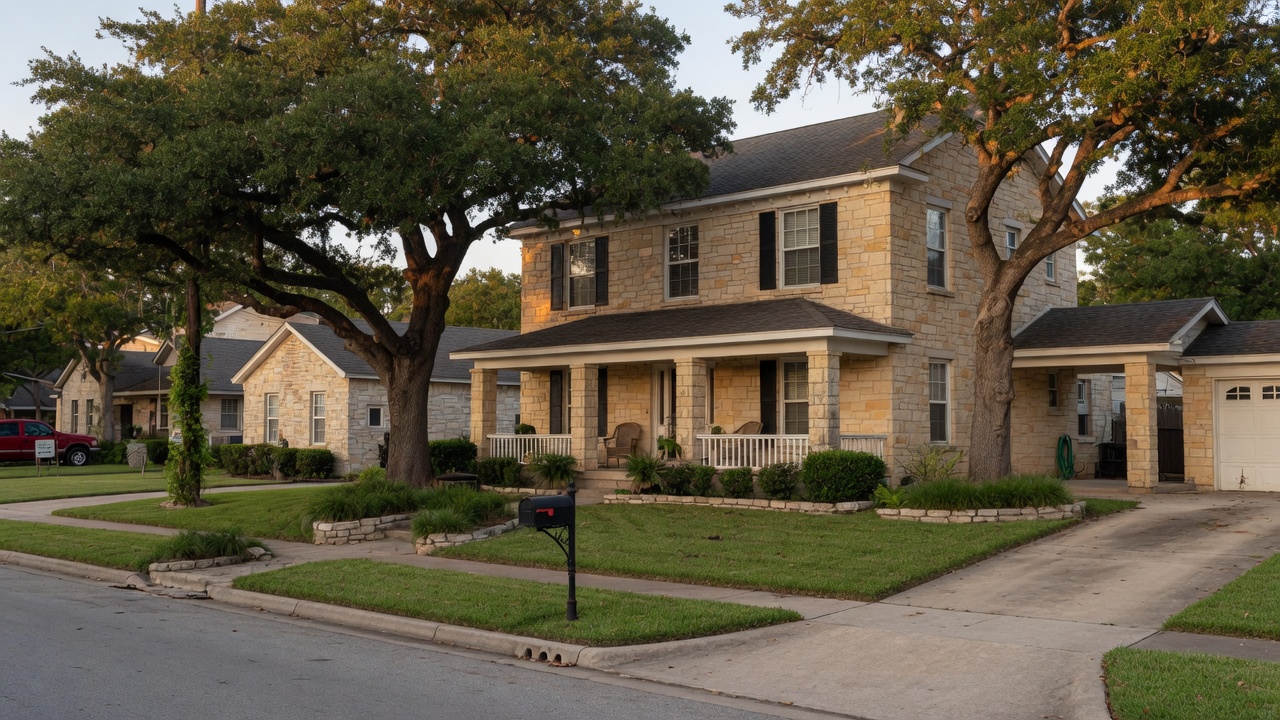
Special taxing districts do not only affect new construction. Established resale homes in Hill Country neighborhoods carry the same ongoing tax obligations.
Key Takeaway
- •The property tax rate on a home is not a single number — it is a composite of county, school district, city, and special district levies.
- •Special districts (MUDs, ESDs, and others) can add $0.50 to $1.50 or more per $100 of taxable value on top of the base tax rate — for both new construction and resale homes. PIDs add separate special assessments (annual installments plus interest) rather than ad valorem taxes — the actual amount depends on the apportionment method in the property's Service and Assessment Plan.
- •That layered cost translates to $200 to $500+ per month in additional housing costs on a typical Hill Country home.
- •You can and should identify these districts before you make an offer — regardless of whether the home is new or resale.
Why the Seller's Tax Bill May Not Be Your Tax Bill
The seller's tax bill reflects their exemptions, their capped appraised value, and their specific assessment history — none of which transfer to you as the buyer.
- •Homestead appraisal cap: If the seller has lived in the home for years, their appraised value may be capped well below current market value (up to 10% annual increase from the year they qualified). You will not inherit the seller's capped appraised value. For planning purposes, use the CAD's current market value rather than the seller's capped appraised value. The CAD will determine the property's value for the applicable tax year as of January 1.
- •Over-65 exemption: If the seller is 65 or older, they may have a school district tax ceiling — a maximum dollar amount that prevents their school tax from rising. You will not inherit that ceiling.
- •Disabled-person or disabled-veteran exemption: The seller may receive additional exemptions based on disability status — each requiring separate eligibility and application. These do not carry over.
- •Agricultural or wildlife valuation: If the seller's land qualifies for ag-use or wildlife management valuation, their appraised value is based on productive use — not market value. That valuation likely does not apply to you as a residential buyer. Changing the land's use can also trigger roll-back taxes — a three-year recapture of the difference between taxes based on productivity value and taxes based on market value; penalties and interest may apply if the resulting bill becomes delinquent.
The buyer's tax burden will be calculated on a different basis. Use the tax bill to identify which entities tax the property and their rates, then apply those rates to the CAD's current market value (not the seller's capped appraised value) minus your own exemptions. See How to Estimate Your Actual Tax Bill for the step-by-step method.
How Texas Property Tax
Actually Works
Texas has no state income tax. What most people don't realize is that the absence of income tax is the primary reason property taxes exist at the levels they do. Property tax is not a side effect of homeownership in Texas — it is the primary funding mechanism for local government, public schools, roads, and emergency services.1
The numbers are straightforward: Texas combined property tax rates typically range from 1.5% to 2.5% of assessed value, and in areas with special taxing districts, the combined tax rate can climb to 3.0% or higher.1 That is two to three times what most California buyers are accustomed to paying.
But the rate you see on a listing — or the one a builder quotes on a price sheet — is rarely the full picture. Understanding why requires understanding how the rate is assembled.
Combined Tax Rate vs. Effective Tax Rate
When a listing says a home has a "tax rate of 2.1%," that number is a combined tax rate — the sum of every taxing jurisdiction's adopted rate, added together. It includes the county rate, the school district rate, the city rate, and any special district ad valorem rates (MUD, ESD, and so on), all stacked on top of one another. PID assessments — which are special assessments, not ad valorem taxes — may appear separately and are not included in the combined tax rate figure.
The effective tax rate (total taxes paid as a percentage of market value) is different — it accounts for exemptions and appraisal caps, so it is almost always lower than the combined rate. A $500,000 home paying $10,000 in total taxes has an effective rate of 2.0% even if the combined rate is 2.4%. Hypothetical illustration
The combined tax rate emerges from the overlap of multiple independent taxing authorities, each with its own rate-setting process and bond obligations.
How Jurisdictions Layer
Every property in Texas is taxed by a combination of overlapping entities — not one entity, but several, all at once:
- County — funds county government, roads, courts, and general services. Typically $0.20 to $0.40 per $100 of taxable value.2
- School District — the largest single component of most tax bills, funding K–12 education. Rates typically range from $0.80 to $1.15 per $100 depending on the district.3
- City (if within city limits) — funds municipal services. Can range from $0.20 to $0.65 per $100.
- Special Districts — MUDs, ESDs, WCIDs, road districts, and others levy ad valorem taxes. PIDs, which are created by a city or county rather than existing as independent taxing authorities, add special assessments rather than ad valorem taxes. These are the layers this article focuses on, and they are where most of the cost surprise lives.
A home inside Boerne city limits, for example, might be taxed by Kendall County, Boerne ISD, the City of Boerne, and one or more special districts — all simultaneously. A home five miles outside city limits might skip the city tax but pick up an ESD and a MUD instead. The combined tax rate can be quite different, even within the same county. Hypothetical illustration

The layers of taxing jurisdictions that stack onto every Hill Country property tax bill. Special districts (MUD, ESD) sit on top of the base county, school, and city levies. PIDs add special assessments — not ad valorem taxes — as an additional cost.
Key Takeaway
Your property tax rate is the sum of every overlapping jurisdiction — not a single number set by one entity. Special districts are additional layers that sit on top of the base county and school district rates, and they can double or triple the impact on your monthly payment.
Special Districts — The Layers
Beneath Your Tax Bill
Texas has more than 2,300 special purpose districts that levy property taxes.4 These are independent government entities created to fund specific services — water infrastructure, roads, emergency response, drainage — that the county or city does not cover on its own. In new-growth areas like the Hill Country, special districts are not unusual. They are the standard mechanism for financing the infrastructure that makes a new subdivision possible.
Here are the five types most likely to appear on a Hill Country tax bill.
MUD — Municipal Utility District
Most common in new Hill Country developments

MUDs fund the core infrastructure a new subdivision needs: water supply lines, wastewater and sewer systems, stormwater drainage, and roads.
A Municipal Utility District is an independent political subdivision created to finance and maintain water supply, wastewater treatment, drainage, and road infrastructure for a specific development or geographic area.5 In the Hill Country, where there is no existing municipal water or sewer system, a MUD is typically the vehicle used to fund the infrastructure.
Here is how it works: The developer pays upfront to build water lines, sewer systems, roads, and drainage. The MUD then issues tax-exempt municipal bonds to reimburse the developer for those costs. The bond debt is repaid over 20 to 30 years through a property tax levied on every homeowner within the district.6
MUD tax rates typically range from $0.25 to $1.50 per $100 of taxable value, depending on the amount of bond debt outstanding and the infrastructure being maintained.7 On a $750,000 home with no applicable exemptions, that translates to an additional $1,875 to $11,250 per year — on top of the county, school, and city taxes.
MUD Rate Breakdown: M&O vs. I&S
A MUD typically levies two separate tax rates that combine into the total MUD rate you see on your tax bill. Understanding the difference matters — especially when estimating how your tax burden will change over time.
Maintenance & Operations (M&O) rate — Funds day-to-day operations: water treatment, sewer maintenance, infrastructure upkeep, and administrative costs. It does not go away when bonds are paid off.
Interest & Sinking (I&S) rate — Also called the debt service rate. This repays the bonds issued to fund initial infrastructure. The I&S rate may decline as debt is retired and can reach zero when all bonds are retired, assuming no new bonds are taken on.
The total MUD tax rate is M&O + I&S. Early in a district's life, the I&S portion is typically larger. As bonds mature, only the I&S portion is affected — and whether the total rate actually declines depends on the repayment schedule and new debt issuance.
Example: Hypothetical illustration A MUD with a total rate of $1.25 per $100 might have a $0.45 M&O rate and a $0.80 I&S rate. When bonds are paid off, the I&S rate drops to zero — but the $0.45 M&O rate remains. "Bonds paid off" does not mean no more MUD tax.
See How Bond Debt Turns Into Your Monthly Payment for how this translates to your monthly cost.
MUD utility charges are separate from property taxes. MUDs often provide water and sewer service directly — these charges appear on a separate bill and are not part of the ad valorem tax. Budget for both the MUD property tax and the MUD utility charges.
PID — Public Improvement District
Created by a city or county — not an independent taxing authority

PIDs can fund a broad range of public improvements — from infrastructure like roads, drainage, and utilities to neighborhood enhancements such as parks, landscaping, lighting, sidewalks, and trails.
A Public Improvement District is a defined geographic area — created by a city or county — where property owners pay a special assessment (not a traditional property tax) to fund public improvements including infrastructure, parks, landscaping, lighting, sidewalks, and trail systems.8 Unlike a MUD, a PID is not an independent taxing authority — it does not levy ad valorem property taxes.
PID assessments are typically structured as annual installments plus interest, rather than a single lump sum. Texas law permits assessments to vary annually, and outstanding balances may be prepaid. There is no dependable statewide typical PID rate — Texas law allows costs to be apportioned using different methods based on special benefit, including frontage, square footage, property value, or other formulas. To determine the specific amount that applies to your property, consult the property's actual assessment roll and the PID's current Service and Assessment Plan.
A PID may include capital assessments for infrastructure, bond installments tied to a repayment schedule, and ongoing service or maintenance assessments for landscaping, security, or common-area upkeep — each with its own duration. Ongoing service assessments may have no fixed expiration at all. See PID Due Diligence Checklist for the documents to request.
WCID — Water Control and Improvement District
Water supply, flood control, and drainage
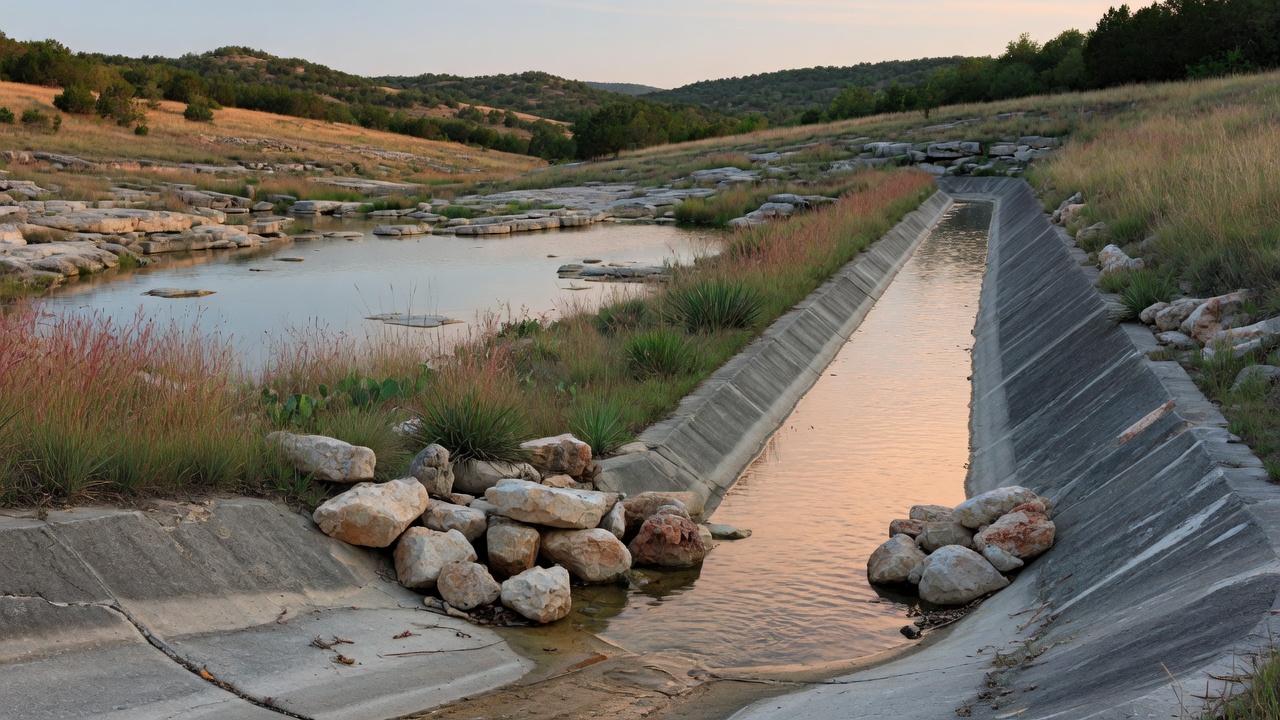
WCIDs manage water supply, flood control, stormwater drainage, and sometimes wastewater — particularly important in the Hill Country where karst topography and flash-flood geography demand complex water management.
A Water Control and Improvement District manages water supply, flood control, stormwater drainage, and sometimes wastewater for a specific area.9 WCIDs are particularly common in the Hill Country, where the Edwards Aquifer (Edwards Aquifer Authority — learn more), karst topography (USGS overview — learn more), and flash-flood geography create complex water management challenges.
WCIDs function similarly to MUDs in that they can issue bonds and levy property taxes to repay them. In some developments, a WCID and a MUD may overlap — meaning homeowners pay taxes to both entities. The tax rate for a WCID typically falls in the range of $0.10 to $0.50 per $100 of taxable value, though this varies with the scope of infrastructure managed.
ESD — Emergency Services District
Fire protection and emergency medical services

ESDs fund fire protection and emergency medical services in unincorporated areas — a permanent levy that does not sunset.
An Emergency Services District funds fire protection and emergency medical services in areas outside incorporated city limits.10 ESDs are most common in unincorporated areas — precisely where many Hill Country properties are located.
In Bexar County, ESD tax rates have ranged from approximately $0.06 to $0.10 per $100 of taxable value.10 On a $750,000 home that adds $450 to $750 per year. In some Hill Country areas, ESD rates can be higher.
Unlike MUD taxes and PID assessments, ESD taxes are ongoing levies — they do not sunset when bonds are paid off. They are a permanent layer for as long as the district exists.
Road Utility Districts
Local road construction and maintenance

Road utility districts fund the construction and maintenance of local roads within a defined area, particularly in newer developments where county roads must be built or upgraded.
Road utility districts fund the construction and maintenance of local roads within a defined area, most common in newer developments. Like MUDs, they can issue bonds and levy ad valorem taxes — typically $0.05 to $0.20 per $100 of taxable value, one more layer that compounds the total rate.
"These districts are not inherently harmful. They fund the infrastructure that makes communities possible. The problem is not their existence — it is that most buyers do not know they exist until the first tax bill arrives."
The California Connection:
Mello-Roos and CFDs
If you are relocating from California, the concept of a MUD is not entirely new to you. You've likely encountered a related mechanism — one that most California buyers already pay without thinking twice about it. Understanding the parallels between Texas special districts and California's Mello-Roos/CFD system gives you a significant head start in evaluating your true housing cost in the Hill Country.
California's Closest Analogue to a Texas MUD
California created the Mello-Roos Community Facilities Act of 1982 to address a similar challenge: funding infrastructure for new developments. Under this law, an authorized local agency — such as a county, city, or special district — may form a Community Facilities District (CFD) that issues bonds for roads, schools, water systems, sewer lines, parks, and other public facilities. Homeowners within the CFD pay a special tax to service that bond debt.22
A CFD is California's closest analogue to a Texas MUD, but the mechanisms differ in important ways. A CFD may finance services in addition to infrastructure, imposes a special tax under its own rate and method of apportionment, and is not structured as an independent political subdivision in the same way a Texas MUD is. The overlap is real — both use bond-funded mechanisms to pay for development infrastructure — but the legal frameworks, rate-setting processes, and governance structures are distinct.
How They Compare: Side by Side
The table below maps Texas MUD and PID features alongside their closest California counterparts. The parallels are useful for California relocators, but remember: these are analogies, not direct equivalents.
| Feature | Texas MUD / PID | California Mello-Roos / CFD |
|---|---|---|
| Purpose | Fund infrastructure and public improvements for new development — MUDs cover roads, water, sewer, parks; PIDs may also cover roads, drainage, utilities, and neighborhood enhancements | Fund infrastructure and services for new development — roads, schools, water, sewer, parks, and ongoing public services |
| Duration | 20–30+ years (MUD bonds). PID capital assessments are paid in annual installments plus interest; assessments may vary annually and can be prepaid. Ongoing service/maintenance assessments may continue indefinitely. | 20–30+ years (typical Mello-Roos bond term) |
| Who bears the cost | Every property within the district boundaries | Every property within the CFD boundaries |
| Transfers with property | Yes | Yes |
| Assessed by | MUD: local appraisal district (county), with tax rate set by the district board. PID: administered by the city or county that created it — not an independent taxing authority | County tax collector, based on the CFD's established tax rate |
| Assessment basis — MUD | Taxable value multiplied by adopted MUD rate | — |
| Assessment basis — PID | Allocation method in current Service and Assessment Plan | — |
| Assessment basis — Mello-Roos | — | CFD's adopted rate and method of apportionment |
| Appears on tax bill | MUD: separate line item on tax bill. PID: may appear on the tax bill or on a separate assessment notice. | Yes — separate line item, often labeled "Special Tax" or "CFD" |
| Buyer disclosure required | MUD: Texas Water Code § 49.452. PID: Texas Property Code § 5.014 — written notice required before a binding contract. | Yes — California Civil Code § 1102.6b (seller disclosure); also typically appears in the Preliminary Title Report |
Where They Differ
The parallels are close enough that California buyers have a useful head start — but the differences matter. The legal frameworks, rate-setting methods, and governance structures are not the same, and those distinctions affect how you evaluate a Texas property.
Naming and structure. California calls them "Mello-Roos" or "CFDs." Texas calls them "MUDs," "PIDs," "WCIDs," and others. MUDs and PIDs are structurally different — a MUD is an independent taxing authority that levies ad valorem taxes, while a PID is created by a city or county and imposes special assessments. If someone mentions a "MUD" in a Hill Country listing, it is worth understanding: a Texas MUD is a closer analogy to a California CFD than it is to any single California tax mechanism.
Rate behavior. Critically, California Mello-Roos rates are typically fixed or follow a disclosed escalation schedule, while Texas MUD rates are set annually and can fluctuate. PID assessments are also permitted to vary annually under Texas law.
The Proposition 13 Difference
Texas has no Proposition 13 equivalent. The 10% annual homestead appraisal cap provides less protection than California's 2% lock on purchase price, and non-homestead properties face only a temporary 20% cap (expiring Dec 31, 2026 for properties ≤$5M). This fundamentally changes how you model long-term housing cost. See Why a Lower Rate Doesn't Mean a Lower Bill for the full analysis.
What This Means for You as a Relocator
If you've been paying a Mello-Roos tax in California, you already understand the core concept. That familiarity is an advantage most Texas buyers do not have. The key adjustment: the 10% homestead cap limits annual increases but still allows significantly more exposure than Proposition 13. A MUD tax on a $750,000 home today could become a MUD tax on an $825,000 home in a single year if the market appreciates 10% — and that growth compounds year after year.
When you see a listing that mentions a MUD or PID, you already know to ask the right questions. For a full walkthrough, see How to Find Special Districts — Step by Step.
Key Takeaway
California Mello-Roos taxes and Texas MUD taxes are closely analogous. PID assessments work differently: they are special assessments structured as annual installments plus interest. The critical adjustment is that Texas's appraisal cap is substantially weaker than Proposition 13. Use your California knowledge to evaluate Texas properties with confidence, but model your long-term costs with the understanding that both the rate and the assessed value can change annually.
MUD vs. PID: What Is the
Difference?
MUDs and PIDs are structurally different — not just different names for the same thing. A MUD is an independent taxing authority that levies ad valorem taxes, while a PID is created by a city or county and imposes special assessments (not taxes). Both add to your monthly cost, but they fund different things, operate on different timelines, and carry different implications for your long-term housing expense.
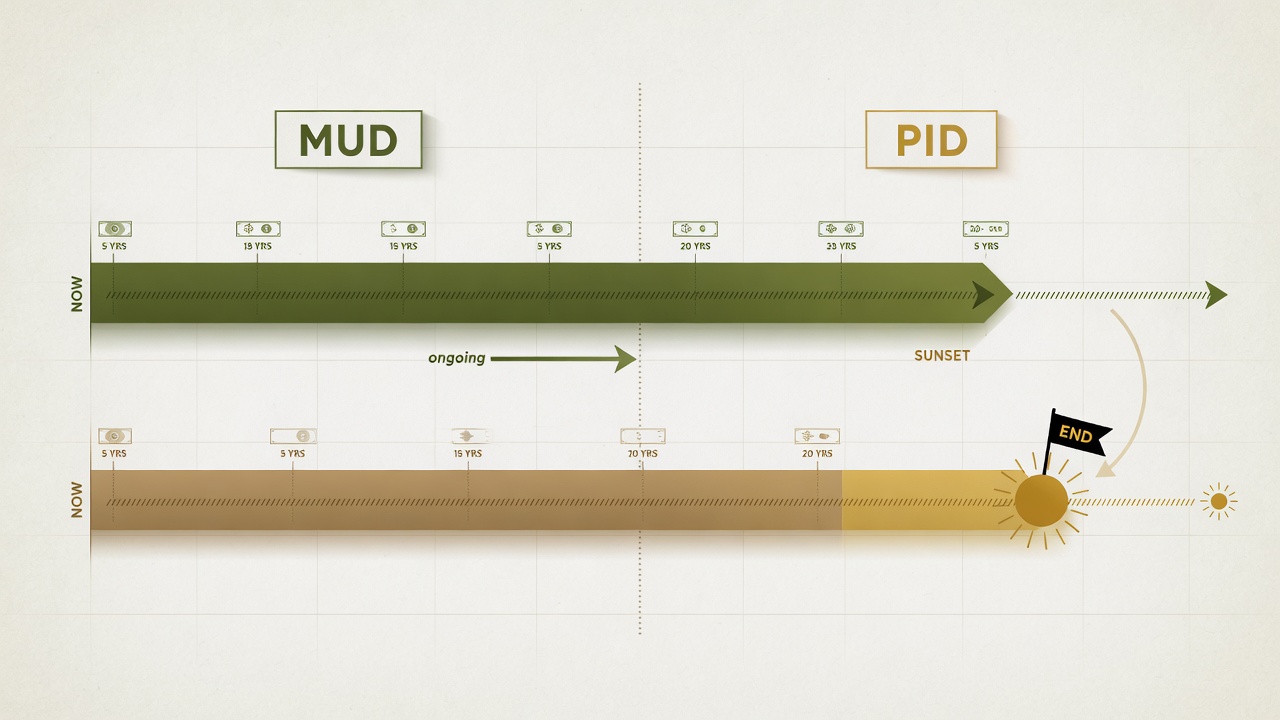
MUD taxes tend to be long-term or permanent obligations. PID assessments have multiple components — capital assessments, bond installments, and ongoing service assessments — each with its own duration and terms. Always verify the specifics through the district's documents.
| Feature | MUD — Municipal Utility District | PID — Public Improvement District |
|---|---|---|
| What it funds | Water supply, wastewater/sewer, drainage, roads, and core infrastructure | Public improvements including infrastructure (roads, drainage, utilities) as well as neighborhood enhancements (landscaping, lighting, parks, trails, sidewalks) |
| Why it exists | To build infrastructure in areas where no municipal water, sewer, or roads exist — typically new subdivisions on previously undeveloped land | To fund public improvements — infrastructure, roads, drainage, utilities, and neighborhood enhancements — for a specific area, as authorized by the city or county that created it |
| Legal mechanism | Ad valorem property tax — an independent government taxing authority levying taxes based on appraised value, subject to appraisal-district oversight | Special assessment (not an ad valorem tax) — annual installments plus interest and administrative costs, imposed on properties within the district, administered by the city or county that created it. Not an independent taxing authority. |
| Typical rate | $0.25 to $1.50 per $100 of taxable value | Varies by community — no statewide typical rate. Assessed per the property's Service and Assessment Plan using frontage, square footage, property value, or other benefit-based apportionment methods. |
| Annual cost on a $750K home | $1,875 to $11,250 per year | See the property's actual assessment roll or Service and Assessment Plan for the specific annual amount — cost varies by property and apportionment method. |
| Duration | Long-term — bonds typically repaid over 20–30 years, but new bonds can be issued; in practice, many MUDs have no clear end date | Varies by assessment type — terms differ widely and can extend much longer than buyers expect. Bond-financed capital assessments may have a defined repayment term; ongoing service/maintenance assessments may have no fixed expiration. Assessments are paid in annual installments plus interest, may vary annually, and outstanding balances can be prepaid. |
| Can it be extended? | Yes — new bonds can sustain or increase the tax rate, especially in multi-phase developments | Duration depends on the service and assessment plan, annual updates, and bond documents — not a fixed statutory expiration. Texas law permits assessments to vary annually, so the dollar amount may change from year to year. |
| Key difference for resale buyers | A resale home in a MUD may still carry 10–20+ years of bond debt. The tax burden does not reset when the home changes hands. | A resale home in a PID may still carry active assessment obligations — and assuming the PID has expired based on its age or the home's resale status is a common mistake. Different components of the assessment (capital, bond installments, and ongoing service assessments) each have their own duration, and some may continue indefinitely. Outstanding PID assessments can also be prepaid at closing. |
| What to verify | Outstanding bond amount, remaining bond term, and whether additional bonds are planned | Current service and assessment plan, annual assessment roll, bond documents (for outstanding bonds), and whether ongoing service assessments have no expiration |
A MUD tax is more likely to be a long-term or permanent layer on your tax bill, because the district can refinance and issue new bonds. A PID's structure is fundamentally different — special assessments paid in annual installments plus interest.
Key Takeaway
MUDs are independent taxing authorities that fund infrastructure and typically carry long-term bond obligations. PIDs are created by a city or county and fund public improvements through special assessments — not ad valorem taxes. When evaluating a resale home, ask: What does the current service and assessment plan say about each assessment component's duration?
How Bond Debt Turns Into
Your Monthly Payment
To understand why special districts move your monthly payment, you need to understand one mechanism: municipal bond financing.
When a developer builds a new Hill Country subdivision, the infrastructure — water lines, sewer connections, drainage systems, roads, and sometimes parks and amenities — must be built before the first home closes. The cost can run millions of dollars.
Rather than absorb that cost entirely, the developer works with the state to create a special district. In the case of a MUD, the district issues tax-exempt municipal bonds to reimburse the developer for the infrastructure costs.11 In the case of a PID, the city or county that created the district funds improvements through special assessments imposed on properties within the district — annual installments plus interest and administrative costs — rather than through bond-backed ad valorem taxes.
A MUD repays those bonds over a term of 20 to 30 years using property taxes levied on every property owner within the district boundaries. This bond repayment is in addition to the base county, school, and city taxes. It appears on your tax bill as a separate line item — often labeled "debt service" or "MUD bond repayment." The bond repayment portion is the I&S (interest and sinking) component of the MUD rate. See MUD Rate Breakdown: M&O vs. I&S for how the total MUD rate splits between operations and debt service.
The critical insight is this: the bond debt portion of your MUD tax bill is a separate levy that can sometimes equal or exceed the base tax rate itself. In a newly developed subdivision where bonds are freshly issued and at their highest outstanding balance, the MUD bond debt service can represent $0.50 to $1.50 per $100 of taxable value — effectively doubling the tax rate you expected. PID assessments, by contrast, are special assessments (not ad valorem taxes) and carry their own installment-based structure.
For resale buyers: The bond debt does not retire when the original buyer sells. A resale price that seems competitive may carry a tax burden that makes the true monthly cost significantly higher than a comparable home outside the district — always check the remaining bond term.
How a Combined Tax Rate Is Assembled
Illustrative example: $750,000 home in a Hill Country development with MUD + ESD. Rates per $100 of taxable value (shown here at full appraised value before exemptions). This applies equally whether the home is new construction or resale. Hypothetical illustration
Why a Lower Rate Doesn't
Mean a Lower Bill
This is one of the most dangerous half-truths in Texas real estate. The bond debt section above explains that MUD tax rates may decline over time as bonds are paid off — but that is not guaranteed, because new debt, changing valuations, and altered repayment schedules can offset or reverse the trend. And even when the rate does decline, a declining rate does not guarantee a declining tax bill — and in fast-appreciating Hill Country markets, it often does not.
How Texas Assessed Values Work
Texas Appraisal Districts — including the Kendall County Appraisal District, Bexar County Appraisal District, and Comal County Appraisal District — are required by law to reappraise all property at least once every three years at 100% of their current market value.19 This is not optional. The appraisal district determines what your home is worth on the open market at least once every three years — and in practice, most Hill Country CADs appraise property more frequently. But your property tax is not calculated on that appraised market value — it is calculated on the taxable value, which is the appraised value after the application of appraisal caps, exemptions, and any special valuations. Each taxing entity applies its own adopted rate to the property's taxable value for that entity, and the taxable value can differ from one entity to another depending on which exemptions each entity honors.
The formula for each taxing entity is: Tax = Taxable Value × That Entity's Adopted Rate. Both variables can change every year. The taxable value is derived from the appraised value after any applicable caps, exemptions, and special valuations — so the number being multiplied by the rate is usually lower than the appraised market value. If the rate goes down but the taxable value goes up faster, the dollar amount you owe goes up. The rate is only half the equation — and it's the half that most people fixate on while ignoring the other.
The Proposition 13 Gap
This dynamic is particularly jarring for California relocators. Under Proposition 13, your assessed value is locked at purchase price with annual increases capped at 2%.20 In Texas, qualifying homesteads receive a 10% annual cap — not 2%, not locked to acquisition value. Non-homestead properties face only a temporary 20% cap for properties valued at $5 million or less (expiring December 31, 2026), and properties above $5M receive no cap. A home that appreciated 23.5% in three years could see its appraised value increase by 10% per year under the homestead cap, meaning the tax bill still rises substantially even with the protection in place.
A Worked Example
Consider a buyer who purchases a home in a MUD in 2025 for $425,000. The local appraisal district determines the property's market value as of January 1 — the purchase price is one data point the CAD considers, but it does not automatically become the appraised value, particularly in Texas where the CAD may not have the exact sale price. For this example, suppose the CAD appraises the property at $425,000. Because this is the first year of ownership and no exemptions have yet been applied, the property's taxable value for the MUD equals the appraised value of $425,000 (most MUDs have not adopted a local-option homestead exemption). The MUD debt service (I&S) tax rate is $0.85 per $100 of taxable value. Note: this is the I&S (interest and sinking) component only — the M&O (maintenance and operations) rate is a separate, ongoing charge. See M&O vs. I&S above.
| Initial Assessment (2025) | Three Years Later (2028) | |
|---|---|---|
| Taxable Value (MUD) | $425,000 | $525,000 |
| MUD Rate (per $100) | $0.85 | $0.70 |
| MUD Tax Owed | ~$3,613/yr | ~$3,675/yr |
| Rate Change | — | ↓ 17.6% decrease |
| Bill Change | — | ↑ Higher, not lower |
The MUD rate dropped by 17.6% as bonds were paid down — exactly what the bond schedule promised. But the home's assessed value rose from $425,000 to $525,000 — a 23.5% increase over three years — which is realistic for fast-growing corridors like Boerne and Fair Oaks Ranch where Hill Country demand has been relentless. The result: the homeowner's MUD tax increased by roughly $62 per year despite a substantially lower rate.
And that is only the MUD portion. The school district rate — typically the largest single component of the tax bill — is applied to the same market-value assessment. If Boerne ISD or Comal ISD rates hold steady while the home appreciates, that portion of the bill rises too. The county portion follows the same logic. A declining special-district rate may reduce the total combined tax rate, but if every other component is applied to a higher assessed value, the net effect can still be a larger annual bill.
What This Means in Practice
A buyer who purchases based on today's MUD rate and today's assessed value may face a meaningfully higher tax bill within two to three years if the area appreciates rapidly — which is common in Hill Country growth corridors. The rate trajectory looks favorable on paper. The bill trajectory does not follow.
This is not a flaw in the system. It is how Texas property tax is designed to work. The appraisal district's job is to reflect market reality, and the market in much of the Hill Country has been appreciating faster than bond rates are declining.
Key Takeaway
- •Rate contraction does not equal tax bill contraction. Your tax bill is the product of assessed value multiplied by the rate — if value rises faster than the rate falls, you owe more.
- •Always project your tax trajectory based on both the rate trend and the local appreciation trend — not just today's rate.
- •Ask your agent or tax advisor to model a three-to-five year projection using both declining rates and increasing assessed values — especially important for California relocators accustomed to Proposition 13's 2% cap.
The Monthly Payment Impact:
Four Scenarios, One Home Price
The following examples use a $750,000 home — a realistic price point for Hill Country and Boerne-area properties — with realistic combined tax rate ranges for each scenario. Scenarios 1–3 apply to both new construction and resale purchases. Scenario 4 illustrates a common resale situation where the MUD has partial bond debt remaining.2
Understanding Tax Exemptions
The table below uses pre-exemption values — the full tax calculated on the entire appraised value without exemptions. Most homeowners qualify for at least one exemption and will pay less. Here are the key exemptions:
- •Homestead Exemption: Reduces the school district portion by up to $140,000 off appraised value. Counties and cities may offer additional reductions.12
- •Over-65 / Senior Exemption: An additional $60,000 school district exemption (total $200,000), plus a school district tax ceiling that caps the annual school tax bill at the amount owed when the exemption was claimed.13
- •Disabled-Person Homestead Exemption (§11.13): Available to individuals who qualify for federal Social Security disability insurance (SSDI). The federal government determines who qualifies as disabled; taxing units may choose whether to adopt the exemption and at what amount, but they do not set separate eligibility criteria. Separate from the disabled-veteran exemption — different statute, different application process.14
- •Disabled-Veteran Homestead Exemption (§11.22): Scales with VA disability rating — $5,000 (10%–29%), $7,500 (30%–49%), $10,000 (50%–69%), $12,000 (70%–99%). A full exemption under §11.131 is available for veterans receiving 100% VA disability compensation with a 100% rating or IU determination.15
- •Agricultural / Wildlife Valuation: Taxes land based on productive use rather than market value. Less common in typical residential purchases but relevant for rural acreage.
Note: The disabled-person exemption (§11.13) and the disabled-veteran exemption (§11.22/§11.131) are separate programs with different statutes, eligibility criteria, and application processes. The disabled-person exemption requires qualifying for federal Social Security disability insurance (SSDI); the disabled-veteran exemption requires a VA disability rating. A VA disability rating does not qualify someone for the disabled-person exemption; an SSA disability determination does not qualify someone for the disabled-veteran exemption.
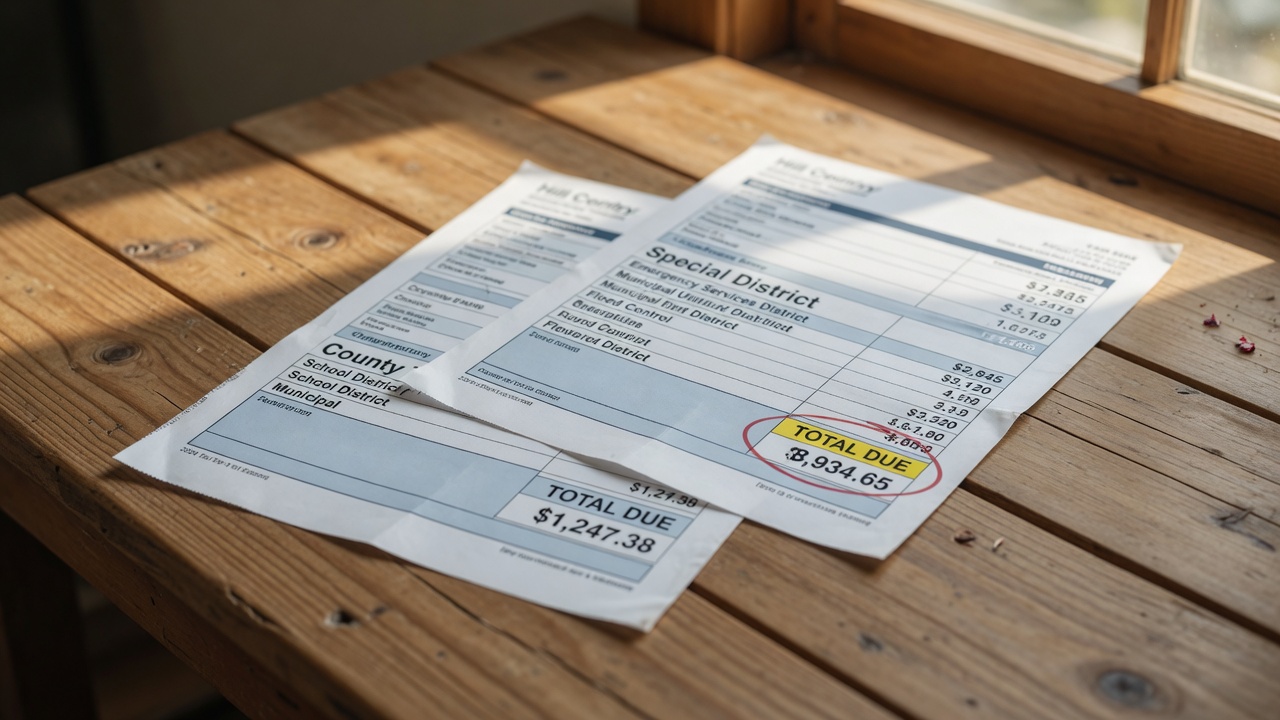
The same assessed value, two very different tax bills. The difference is entirely driven by which special taxing districts apply to the property.
| Tax Component | Scenario 1 No Special Districts | Scenario 2 MUD + ESD | Scenario 3 MUD + PID + ESD | Scenario 4 Resale in MUD (partial bonds remain) |
|---|---|---|---|---|
| Ad Valorem Tax Rates (per $100 of taxable value) | ||||
| County | $0.32 | $0.32 | $0.32 | $0.32 |
| School District | $0.92 | $0.92 | $0.92 | $0.92 |
| MUD | — | $0.70 | $0.70 | $0.45 |
| ESD | — | $0.08 | $0.08 | $0.08 |
| Ad Valorem Subtotal | 1.24% | 2.02% | 2.02% | 1.77% |
| Annual Ad Valorem Tax | $9,300 | $15,150 | $15,150 | $13,275 |
| Non-Ad Valorem Special Assessments (flat annual $) | ||||
| PID Assessment | — | — | $1,875/yr | — |
| Non-Ad Valorem Subtotal | $0 | $0 | $1,875 | $0 |
| Combined Annual Cost (Ad Valorem + Special Assessments) | ||||
| Total Annual Cost | $9,300 | $15,150 | $17,025 | $13,275 |
| Monthly Cost (pre-exemption) | $775 | $1,263 | $1,419 | $1,106 |
Ad valorem rates are per $100 of taxable value. In this pre-exemption illustration, the taxable value for each entity equals the full $750,000 appraised value. In practice, exemptions (such as the $140,000 school district homestead exemption) reduce the taxable value for each entity independently. Annual ad valorem taxes = rate × $7,500.
PID Assessment: PID assessments are special assessments — not ad valorem taxes — structured as annual installments plus interest and administrative costs. The $1,875/yr for Scenario 3 is an illustrative annual amount based on a $750,000 home. PID assessments are allocated by benefit-received matrix or fixed square-footage/lot allocation — they are not tax rates and are not subject to homestead exemptions. Texas law permits assessments to vary annually, and outstanding balances can be prepaid. Buyers should confirm with the title company or PID administrator what the current assessment is, how it is allocated, and how it may change.
The same $750,000 home produces monthly tax bills ranging from $775 (no special districts) to $1,419 (MUD + PID + ESD) — a difference of $644 per month driven entirely by which districts tax the property. Even a resale in a MUD with partially retired bonds (Scenario 4) adds $331 per month over the baseline, because the M&O (operations) rate continues regardless of bond repayment.
The homestead exemption reduces the school district portion of these numbers, but does not reduce the MUD, ESD, or PID layers — those entities rarely adopt local-option homestead exemptions, and PID assessments are special assessments (not ad valorem taxes) that are not subject to homestead exemptions at all.
Purchasing Power and Resale Impact
This tax difference directly reduces how much home you can afford. A buyer pre-approved at $5,200/month may qualify for an $850,000 home without special districts, but only a $745,000 to $770,000 purchase in a MUD + PID + ESD area.
When you eventually sell, informed buyers will run the same analysis. A home with $600+/month in special-district costs has a narrower pool of qualified buyers — a real consideration for long-term ownership.
Key Takeaway
Two homes priced identically at $750,000 can produce monthly tax bills that differ by $488 to $644 or more — purely based on which special taxing districts apply. That gap compounds over the life of your loan and directly reduces your purchasing power. Resale does not automatically mean lower special-district taxes; the remaining bond term matters more than the age of the home.
Three Hill Country Case Studies
The scenarios above show the impact of special districts. These three case studies show the mechanics — the three separate value numbers on your tax bill (market value, appraised value, and taxable value), how exemptions work, and how the math produces your actual dollar amount. Each case uses realistic Hill Country values in the $725,000 to $775,000 range and current published tax rates.
Case Study 1: Property WITHOUT a Special District
Kendall County, outside city limits, Boerne ISD and Cow Creek GCD
This is the cleanest tax structure in the Hill Country, and when you find one, it's a good day. You purchase a resale home in Kendall County outside any city limits. The property is taxed by Kendall County, Boerne ISD, and the Cow Creek Groundwater Conservation District only. No MUD, no PID, no ESD.
Step 1: The Three Value Numbers
- •Assumed purchase price and CAD market value: $775,000.
- •Appraised value (assessed value): $775,000 — the county appraisal district's determination of market value as of January 1. In year one, the CAD appraises the property at its estimate of market value; your purchase price may be one piece of evidence but does not automatically set the appraised amount (Texas is a nondisclosure state). In this example, the appraised value matches the purchase price.
- •Taxable value: The appraised value minus your exemptions. This is the number each taxing entity actually applies its rate to.
Step 2: Apply Your Exemptions
You qualify for the standard homestead exemption (you will use this as your primary residence).
- •School district taxable value: $775,000 − $140,000 (homestead) = $635,000
- •County taxable value: $775,000 (Kendall County shows no general homestead exemption in the 2025 official rate table)
Step 3: Calculate Each Tax
Kendall County: $775,000 × 0.377% = $2,922
Boerne ISD: $635,000 × 1.0109% = $6,419
Cow Creek GCD: $775,000 × 0.005% = $39
Total estimated annual tax: $9,380
Monthly: $782
Effective Rate Summary
Combined tax rate (county + ISD + Cow Creek GCD): 1.3929%
Effective rate (total tax ÷ market value): 1.21%
The effective rate is lower than the combined rate because the $140,000 school district homestead exemption reduces the taxable base for ISD taxes below the $775,000 market value.
No special districts. No surprises. A combined rate of 1.3929% — about the lowest you will find in the Hill Country — translates to a monthly tax of $782. This is the baseline that Case Studies 2 and 3 are measured against.
Case Study 2: MUD Property in Kendall County
Kendall County, Boerne ISD, Cow Creek GCD, Kendall County MUD #1
You purchase a new-construction home in a master-planned community within Kendall County MUD #1. The MUD issues ad valorem taxes to repay infrastructure bonds. The published total MUD rate is $0.65 per $100 of taxable value — see M&O vs. I&S above for how MUD rates typically split between operations and debt service.
Step 1: The Three Value Numbers
- •Market value: $725,000
- •Appraised value: $725,000 (year one — no cap has built up yet)
- •Taxable value: $725,000 minus your exemptions (see below)
Step 2: Apply Your Exemptions
- •School district taxable value: $725,000 − $140,000 = $585,000
- •County taxable value: $725,000 (no Kendall County general homestead exemption per 2025 official table)
- •Cow Creek GCD taxable value: $725,000 (no homestead exemption)
- •MUD taxable value: $725,000 (MUDs rarely adopt local-option percentage homestead exemptions; when they do, the exemption applies across the entire MUD levy. The full appraised value is used because most MUDs have not exercised this option)
Step 3: Calculate Each Tax
Kendall County: $725,000 × 0.377% = $2,733
Boerne ISD: $585,000 × 1.0109% = $5,914
Cow Creek GCD: $725,000 × 0.005% = $36
Kendall County MUD #1: $725,000 × 0.65% = $4,713
Total estimated annual tax: $13,396
Monthly: $1,116
MUD Delta: What the MUD Actually Costs You
To see the true cost of the MUD, compare this home to a hypothetical $725,000 home in the same county and school district but without a MUD:
Without MUD: Kendall County $2,733 + Boerne ISD $5,914 + Cow Creek GCD $36 = $8,683/yr ($724/mo)
With MUD: All layers combined = $13,396/yr ($1,116/mo)
The MUD adds $4,713 per year — $393 per month
Effective Rate Summary
Combined tax rate (county + ISD + Cow Creek GCD + MUD): 2.0429%
Effective rate (total tax ÷ market value): 1.85%
The MUD raises the combined rate by 0.65 percentage points — from 1.3929% (baseline) to 2.0429%. On a $725,000 home, that 0.65% translates to $4,713 per year in additional tax.
The MUD adds $4,713 per year — $393 per month — on top of the base county, school, and groundwater conservation district taxes. The MUD alone raises the combined tax rate from 1.3929% to 2.0429%. On a $725,000 home, that is the difference between a $724/month tax bill and a $1,116/month tax bill — a 54% increase in your monthly tax obligation. The published total MUD rate ($0.65 per $100) reflects the combined effect of operations and debt service. As bonds are repaid, the debt-service portion of the rate may decrease — but MUDs can also issue new bonds for additional infrastructure, which can sustain or increase the total rate. The M&O component continues as long as the district provides services.
Case Study 3: Unincorporated Bexar County with PID
Unincorporated Bexar County, Boerne ISD, with PID assessment — no MUD
This scenario reflects what many buyers encounter in the Boerne-area communities that extend into Bexar County — unincorporated parcels within Boerne ISD boundaries that fall under Bexar County's taxing authority. The property sits in a master-planned community with a Public Improvement District — created by the city or county — that funds public improvements including infrastructure and neighborhood enhancements such as landscaping, parks, lighting, and trail maintenance. There is no MUD, so you can see the PID's cost layered directly onto an illustrative six-entity Bexar County stack.
Unlike Case Study 1 (Kendall County, where only three entities tax the property), a Bexar County parcel carries six separate taxing entities — even without a MUD or groundwater conservation district.
Step 1: The Three Value Numbers
- •Market value: $775,000
- •Appraised value: $775,000 (year one)
- •Taxable value: $775,000 minus your exemptions — and each entity applies its own exemption (or none) independently
Step 2: Apply Your Exemptions
- •School district (Boerne ISD) taxable value: $775,000 − $140,000 (state mandatory homestead) = $635,000
- •Bexar County taxable value: $775,000 − $155,000 (Bexar County's optional 20%-or-$5,000 homestead exemption — 20% of $775,000 = $155,000, which exceeds the $5,000 floor) = $620,000
- •Road & Flood Control: $3,000 plus 20% of appraised value — $3,000 + (20% × $775,000) = $158,000 exemption → taxable value $617,000
- •Alamo Colleges: $5,000 or 1% of appraised value (greater of the two) — 1% × $775,000 = $7,750, which exceeds $5,000 → taxable value $767,250
- •University Health: $5,000 or 20% of appraised value (greater of the two) — 20% × $775,000 = $155,000, which exceeds $5,000 → taxable value $620,000
- •San Antonio River Authority: $5,000 or 4% of appraised value (greater of the two) — 4% × $775,000 = $31,000, which exceeds $5,000 → taxable value $744,000
Step 3: Calculate Each Ad Valorem Tax
Six entities tax this property. Here is each entity, its 2025 adopted rate, the applicable taxable value, and the resulting tax:
Bexar County: $620,000 × 0.276331% = $1,713
Road & Flood Control: $617,000 × 0.023668% = $146
Boerne ISD: $635,000 × 1.0109% = $6,419
Alamo Colleges: $767,250 × 0.149150% = $1,144
University Health (Hospital District): $620,000 × 0.276235% = $1,713
San Antonio River Authority: $744,000 × 0.0183% = $136
Ad valorem total (outside San Antonio): $11,272
The county rate ($0.276331) and Road & Flood rate ($0.023668) are from the 2025 Bexar County Tax Assessor-Collector's published rate table. Boerne ISD's $1.0109 rate was voter-approved November 4, 2025. Alamo Colleges ($0.149150), University Health ($0.276235), and SARA ($0.0183) are from the 2025 adopted rates. The homestead exemptions above reflect the official 2025 Bexar County exemptions: Bexar County uses 20%-or-$5,000 (greater) while Road & Flood Control uses $3,000 plus 20% of appraised value, Alamo Colleges uses $5,000-or-1%, University Health uses $5,000-or-20%, and SARA uses $5,000-or-4%. Note: this estimate excludes any Emergency Services District (ESD) that may apply to the actual property address, as well as any groundwater conservation district — Cow Creek GCD, for example, is a Kendall County entity that does not levy taxes on Bexar County parcels.
Inside San Antonio City Limits: One Additional Entity
If the same property were located inside San Antonio city limits, the City of San Antonio would add a seventh taxing entity. The City's 2025 adopted rate is $0.54159 per $100, and it offers a homestead exemption of 20%-or-$5,000 (greater).
City of San Antonio: ($775,000 − $155,000) × 0.54159% = $620,000 × 0.54159% = $3,358
Ad valorem total (inside San Antonio): $11,272 + $3,358 = $14,630
With assumed PID assessment ($2,100): $16,730/yr ($1,394/mo)
The City of San Antonio rate is from the city's adopted 2025 fiscal year tax rate. The seven-entity stack inside city limits adds roughly $3,358 per year — the equivalent of $280 per month — on top of the six-entity unincorporated total.
Step 4: Add the PID Assessment
PID assessments are structured as annual installments plus interest and administrative costs — not an ad valorem rate. Texas law permits assessments to vary annually. For illustration, assume a PID that charges a capital assessment plus an annual maintenance assessment:
PID capital assessment (annual installment): $1,500
PID maintenance assessment (landscaping, lighting, trails): $600
Total PID assessment: $2,100/year
Step 5: Total Estimated Annual Cost
Ad valorem taxes (all six entities, outside SA): $11,272
PID assessment: $2,100
Total estimated annual tax + assessment: $13,372
Monthly: $1,114
PID Delta: Illustrative PID Cost Impact
Compare this home's ad valorem cost to the PID-inclusive total:
Without PID: Ad valorem only = $11,272/yr ($939/mo)
With PID: Ad valorem + PID = $13,372/yr ($1,114/mo)
The PID adds $2,100 per year — $175 per month
Effective Rate Summary
Combined ad valorem rate (all six entities, before exemptions): 1.7546%
Effective rate (ad valorem only ÷ market value): 1.454%
Effective rate (ad valorem + PID ÷ market value): 1.725%
The combined rate (1.7546%) reflects six overlapping entities — more than double the three-entity stack in Case Study 1 (Kendall County). At the same $775,000 market value, the effective rate (1.454%) is higher than Case Study 1's effective rate (1.21%) and even exceeds its combined rate (1.3929%), and that is before an assumed $2,100 PID assessment is added. Inside San Antonio city limits, the effective rate rises to approximately 1.888% (or 2.159% with the assumed PID) once the City of San Antonio tax is included.
The full Bexar County entity stack is $11,272 before any special district — compared to $9,380 in Kendall County (Case Study 1). At the same $775,000 market value, the ad valorem tax difference between the two counties is roughly $1,892 per year — entirely driven by the six-entity Bexar County stack versus the three-entity Kendall County stack. The PID adds an assumed $2,100 on top. Inside San Antonio city limits, the City of San Antonio tax adds another $3,358, bringing the seven-entity total to $14,630 ($16,730 with the assumed PID). Review the PID Due Diligence Checklist below for the documents to request.
Key Takeaway
Three separate value numbers — market value, appraised value, and taxable value — determine your tax bill. A $775,000 home with county, school, and Cow Creek GCD taxes pays $9,380 per year ($782/mo). Add a MUD, and a $725,000 home pays $13,396 ($1,116/mo) — the MUD alone adds $4,713 per year. In Bexar County, six entities stack onto the same $775,000 home — $11,272 per year before any special district. Add a PID, and the total reaches $13,372 ($1,114/mo) — the PID adds an assumed $2,100 per year as a flat assessment. At the same market value, the Bexar County six-entity stack costs roughly $1,892 more per year than the Kendall County three-entity stack — location alone, no special districts. Inside San Antonio city limits, the City of San Antonio tax pushes the seven-entity total to $14,630 ($16,730 with the assumed PID, or $1,394/mo). Each entity's own homestead exemption reduces its taxable value independently — the savings add up across all six (or seven) entities. The math is transparent once you know which numbers to use.
Downloadable Worksheet
Use the Tax Estimation Worksheet (printable HTML) to calculate your estimated taxes by jurisdiction and by your own exemptions. The worksheet includes fields for market value, appraised value, exemptions, each entity's rate, total estimated tax, and MUD/PID assessments. Print it, fill it out for each property you are evaluating, and bring it to your lender consultation.
Download Tax Worksheet
The DTI Trap: How Special
Districts Can Derail Your Mortgage
Special district taxes do not just stretch your budget — they can determine whether you qualify for a mortgage at all. This is the section that most buyers, and many agents, overlook entirely.
How Lenders Use Taxes in Your Qualification
The lender calculates your Debt-to-Income ratio (DTI) using the full PITI: Principal, Interest, Taxes, and Insurance. Most conventional lenders want this number at or below 43%–45%.
The "T" in PITI is based on the actual projected property tax bill — county, school district, city, and any special districts. PID assessments must also be included in your monthly housing cost. A higher total tax bill means the lender qualifies you for a smaller loan — or may determine you cannot qualify at all.
The Real-World Danger: Failing Underwriting at Closing
Consider a buyer earning $13,000 per month (gross) with $400 per month in other recurring debt, purchasing a $750,000 home with 20% down ($600,000 loan at 7.0%).
Baseline rate (no special districts): approximately 1.80%. Annual tax: $13,500. Total PITI: $5,392/month.
With MUD + PID layers (tax-and-assessment equivalent of approximately 2.85%): Annual tax: $21,375. Total PITI: $6,048/month. That $656/month difference is the combined special district surcharge — enough to move the DTI from a plausible conventional approval to a range where most lenders will decline.
What Special District Taxes Do to a DTI Calculation
Baseline assumptions: $750,000 purchase, 20% down ($150,000), $600,000 loan at 7.0% / 30-year fixed (P&I: $3,992/mo), $275/mo homeowner's insurance, $13,000/mo gross income, $400/mo other debt.
| Scenario | Monthly P&I | Tax & Assessment | Total Housing + Debt | Back-End DTI |
|---|---|---|---|---|
| No special district | $3,992 | $1,125/mo ($13,500/yr) | $5,792 | 44.6% |
| MUD + PID | $3,992 | $1,781/mo ($21,375/yr) | $6,448 | 49.6% |
Tax-and-assessment rates: baseline ~1.80% (county + school + city); MUD + PID ~2.85% tax-and-assessment equivalent including MUD ad valorem plus PID special assessments.
The delta: $656 per month in additional housing cost and 5.0 percentage points on the DTI — the difference between a plausible conventional approval (~44.6%, within the typical 43%–45% target) and a level (~49.6%) where most conventional lenders will decline or require significant compensating factors.
Calculated using standard 30-year amortization on a $600,000 loan at 7.0%. Rates and qualifying thresholds vary by lender and loan program.
If this is discovered late, the buyer has two layers of contractual protection: the option period (typically 7 to 14 days, allowing termination for any reason — lose only the option fee) and the financing contingency (TREC Third Party Financing Addendum — which separately addresses buyer approval, property approval, deadlines, and notice requirements — review the specific terms of your completed addendum with your agent or attorney). Both have expiration dates. Earnest money at stake is typically 1%–2% of the purchase price — $7,500 to $15,000 on a $750,000 home.
New Construction Is Especially Risky
Builders often quote payment estimates using initial MUD rates and PID assessment amounts that can change. The builder's estimated payment may not reflect the full tax burden at closing — or after the first post-construction reassessment. Buyers who rely solely on the builder's estimate may find themselves unable to qualify once the actual tax bill is calculated.
After closing, the lender conducts an annual escrow analysis: if property taxes or homeowner's insurance have increased, your monthly escrow payment goes up to cover the shortfall, and your total monthly housing payment (PITI) rises accordingly. This is a cash-flow change, not a loan modification — your interest rate and principal/interest payment remain locked for the life of a fixed-rate mortgage. Critically, the lender does not re-run your debt-to-income ratio during this annual escrow analysis. Your DTI is only recalculated when you apply for new financing — refinance, home equity loan, or other credit. A buyer who barely qualified at closing may find themselves above the DTI threshold the next time they apply for new financing, even though the lender never reassessed their DTI in the interim.
What I Tell Every Client to Do
Run Pre-Approval With Full Tax Rates
Ask your lender to calculate your pre-approval using the full current tax rate, including all special districts — not just county and school district. If the lender's pre-approval letter does not account for MUD taxes or PID assessments, the qualification number may be wrong.
Get Rates in Writing
Ask the builder or title company for the exact current MUD tax rates and PID assessment rates and have your lender recalculate your DTI with those numbers.
Verify During Your Option Period
Verify the exact taxing jurisdictions — the title company can provide this — and ask your lender to re-run your numbers. The mandatory MUD and PID disclosures should surface this information early, but do not assume they will. Confirm independently.
Get Written Confirmation From Your Lender
Get your lender to confirm in writing that the DTI calculation includes the full current tax rate for every jurisdiction. A verbal "it should be fine" is not underwriting.
Key Takeaway
A MUD tax or PID assessment layer of $656 per month or more can push you above your DTI threshold and disqualify you from a loan. Always have your lender calculate qualification using the full, current tax rate including all special districts — and use your option period and financing contingency early, not at the last minute.
Escrow Shortages: Why Your
Monthly Payment May Go Up
After you close, the lender's annual escrow analysis compares the actual tax bill to what was collected. If the actual bill is higher — due to new construction reassessment, seller exemptions you don't qualify for, incomplete exemption filing, or a rate increase — the lender notifies you of a shortage and raises your monthly payment, sometimes by $150 to $400 or more. This is one of the things I warn every client about up front: your payment at closing may not be your payment six months later.
How to Prepare
- •Budget for a first-year increase. Plan for a potential 10% to 25% increase in your total housing payment, especially with new construction.
- •File your homestead exemption immediately. You can file with the county appraisal district as soon as you close.
- •Request a tax projection before closing. Ask your lender to model PITI using the full tax rate from all entities, not the seller's capped assessment.
- •Set aside reserves. Keep one to two months of additional tax cost in savings as a buffer.
Appraisal District vs.
Tax Assessor-Collector
The Appraisal District (CAD) appraises every property's value and maintains the tax rolls — it tells you what the property is worth and who taxes it. The Tax Assessor-Collector uses those values to calculate and collect your tax — it tells you how much you owe. File exemption applications and value protests with the CAD; request tax certificates and make payments through the Tax Assessor-Collector.
Hill Country Central Appraisal
District Directory
This is your starting point. Look up your property's appraised value, tax rates, and filing deadlines at your county's Central Appraisal District. I keep these bookmarks handy and reference them constantly. Each CAD maintains public records for every property in its jurisdiction — including ownership history, assessed values, exemptions on file, and the taxing entities that levy against the property.
Fair Oaks Ranch — Spans Three Counties
Fair Oaks Ranch is not located in a single county. Depending on the specific address, a property may fall under the jurisdiction of Kendall County, Bexar County, or Comal County — and therefore a different Central Appraisal District. You must determine which county your property is in before looking up tax records. The property address itself, or a quick search on any of the three CAD websites listed below, will tell you which district has jurisdiction.
Kendall County Appraisal District
Covers Boerne, Comfort, and unincorporated Kendall County (also parts of Fair Oaks Ranch — see note above)
Comal County Appraisal District
Covers New Braunfels, Canyon Lake, Spring Branch, and unincorporated Comal County (also parts of Fair Oaks Ranch — see note above)
Bexar County Appraisal District
Covers San Antonio, Helotes, Leon Valley, Shavano Park, and unincorporated Bexar County (also parts of Fair Oaks Ranch — see note above)
Hays County Appraisal District
Covers San Marcos, Dripping Springs, Kyle, Buda, Wimberley, and unincorporated Hays County
Bandera County Appraisal District
Covers Bandera, Lakehills, Medina, Pipe Creek, and unincorporated Bandera County
Medina County Appraisal District
Covers Hondo, Castroville, Devine, and unincorporated Medina County
Guadalupe County Appraisal District
Covers Seguin, Cibolo, Schertz, Marion, and unincorporated Guadalupe County
Key Takeaway
Your county's CAD is the first place to look when evaluating any Hill Country property. Search the address to find the property's current market value and appraised value (if the seller had a homestead cap, the appraised value may be lower than market value — use the market value as your planning baseline), every taxing entity that levies against the property (including MUDs and ESDs), and the applicable tax rates. PID assessments may not appear in CAD records (see Step 7 for PID-specific sources). File your homestead exemption with the same office after closing.
PID Due Diligence Checklist
If you are buying a property within a Public Improvement District, there are specific documents you should request and review before committing to a purchase. PIDs are more complex than MUDs because they can contain multiple assessment types — each with its own duration and terms. This checklist tells you exactly what to ask for and why.
Assessment Roll
Lists the specific dollar amount assessed against each property. Request the most recent version — the roll may be updated annually.
Service and Assessment Plan
A separate document adopted and updated by the PID's governing body — distinct from the original formation documents and assessment ordinance that established the district — specifying what improvements are funded, how assessments are calculated, the payment schedule, and the bond structure. The current SAP and its annual update are the most important operational documents for understanding how a PID's assessments work in practice.
Annual Update to the Service and Assessment Plan
The plan may be updated annually — assessment amounts, components, and terms can change. Always examine the current version, not the original filing.
Payoff Amount
The remaining balance you would pay to satisfy the obligation at closing. Capital assessments in some PIDs can be paid in a lump sum, reducing long-term carrying cost.
Continuing Maintenance Assessment
Covers recurring costs — landscaping, lighting, security, common-area upkeep. This assessment persists even after the capital assessment is paid off — it may continue after the capital assessment is paid and may have no fixed expiration.
Key Takeaway
PIDs may contain multiple assessment types, each with its own duration. Request all five documents above and review them before closing. If the seller cannot provide them, contact the city or county office that administered the PID creation directly.
What the Law Requires:
Mandatory MUD and PID Disclosures
Everything above is about identifying special district costs — asking the right questions, checking public records, and understanding what you are looking at. But there is a separate layer of protection that many buyers, particularly those relocating from out of state, do not know exists: Texas law requires the seller to disclose special district status to you in writing, before you are legally bound to the purchase.
If you are buying a home in Texas — whether new construction or a resale — and the property is within a Public Improvement District or a Municipal Utility District, the law entitles you to specific written notice before you sign a binding contract.
PID Disclosure — Texas Property Code § 5.014
Public Improvement Districts
Texas Property Code § 5.014 establishes a strict, mandatory disclosure requirement for residential real property located within a Public Improvement District. The requirements are unambiguous:
- The seller must provide the buyer with specific statutory written notice before a binding contract, identifying the PID by name and the assessment obligations.
- If the seller fails to provide this notice, the buyer may have termination rights — but timing, waiver, and exception provisions apply. Consult a Texas real-estate attorney regarding rights under a particular contract.
This is a meaningful protection — Texas law requires pre-contract disclosure, giving you the opportunity to evaluate these costs before you are committed.
MUD Disclosure — Texas Water Code § 49.452
Municipal Utility Districts
A parallel disclosure requirement exists for properties within a Municipal Utility District under Texas Water Code § 49.452. The statute requires that:
- The seller must provide written notice that the property is in a MUD, including the district's name, the existence and approximate amount of MUD taxes, and the nature of the district's authority to tax and issue bonds.
- Failure to provide this notice may affect the buyer's rights — but the statute contains timing, waiver, and exception provisions. Consult a Texas real-estate attorney regarding rights under a particular contract.
- MUD disclosures may also appear in TREC Form 59-0, purchase contract addenda, and the title commitment. However, the statutory requirement exists independently — the seller's obligation to disclose is triggered before the contract is signed, not at closing.
If a MUD tax shows up in the title commitment or closing documents but the seller did not disclose it before you agreed to buy, you may have rights — though timing, late disclosure, closing, and statutory exceptions can affect available remedies.
What This Means for You as a Buyer
If you do not receive that notice in a timely manner, you may have termination or damage rights under the statute — but these rights are not automatic. The statutes contain specific timing provisions, waiver provisions, statutory exceptions, and limitations on remedies. For MUD-type water district notices, closing after receiving late notice can waive both the right to terminate and the right to recover damages. If you received notice late or not at all, consult a Texas real-estate attorney regarding rights under a particular contract.
Always ask before you sign. Before entering a purchase contract, ask your agent or title company whether the property is in any special taxing districts, and confirm that the required statutory disclosures have been provided in writing. Do not wait for the closing process to surface this information — by then, you may have already waived your right to terminate on this basis.
New Construction:
Additional Considerations
New-construction buyers face a few additional nuances beyond the universal special-district dynamics. Texas law also requires the seller to disclose MUD and PID status in writing before you sign a binding contract — see mandatory disclosure requirements for details.
The "Year One" Tax Surprise
Before construction, the land is typically assessed at a lower value — often agricultural or unimproved land valuation. When the home is built and the land is reclassified, the assessed value jumps to reflect the new construction. Builders may quote a "tax estimate" based on pre-construction land values — that estimate can be dramatically lower than what you will actually pay once the county appraisal district reassesses the property at full market value with improvements.
Ag Valuation Roll-Back Tax Trap
The "Year One" surprise above mentions that the land's agricultural or wildlife valuation does not transfer to a residential buyer. What that bullet does not cover is the financial penalty triggered when you change the land's use: roll-back taxes.
When a buyer purchases land or a lot that currently holds an agricultural or wildlife valuation under 1-d-1 open-space agricultural or wildlife-management valuation under Subchapter D. Timberland under Subchapter E has related but separate rules. and changes the use to residential — or any non-qualifying use — the county appraisal district triggers roll-back taxes.23 This applies to all buyers of ag-valued or wildlife-valued land transitioning to residential use, with particular risk for buyers of acreage in brand-new developments or master-planned communities where the land recently held ag valuation.
How roll-back taxes work: The county recovers the tax savings the seller received from the ag valuation for the previous three years.23 The bill goes to whoever changes the use — typically the buyer or the developer, depending on the purchase contract. HB 3833 (2021) removed the statutory interest component for common 1-d-1 open-space and wildlife valuation rollback taxes, so the rollback generally recaptures the tax difference without automatic interest. Interest and penalties can arise only if the resulting bill becomes delinquent. Older 1-d agricultural valuation rules may differ.
The dollar amounts can be substantial. The rollback amount is the difference between what the land was taxed at under the ag valuation and what it would have been taxed at at market value, calculated across the preceding three tax years. On Hill Country acreage, that gap can easily run into thousands to tens of thousands of dollars depending on the acreage, the difference between the productive-use valuation and the market-value appraisal, and the applicable tax rates.
New developments are especially dangerous. In a brand-new subdivision or master-planned community, the developer's original land parcel may still carry an ag or wildlife valuation in the appraisal district's records. The developer may have already triggered the rollback by platting and beginning residential construction — or the buyer may trigger it upon taking possession and beginning residential use. Either way, the financial exposure is real and the timing is not always obvious.
What to do: Before closing on any rural or semi-rural lot, request a CAD verification of the property's current valuation status — confirm whether the parcel carries an ag or wildlife valuation. Address rollback liability explicitly in the purchase contract: specify in writing who bears the cost if a rollback is triggered. Do not assume the developer or the seller has already resolved it. A title company or real estate attorney can help ensure this language is included in your contract.
The "Split-Up" Valuation Delay for New Lots
The "Year One" surprise above addresses the jump from pre-construction land value to post-construction improved value. But there is a separate issue that affects buyers of newly subdivided lots: the split-up valuation delay.
When a developer plats a master lot into individual residential lots, the central appraisal district (CAD) needs time to assign individual parcel IDs and update its records. Until that processing is complete, the property may not have its own individual appraisal in the CAD system — the land may still appear under the developer's original blanket parcel. This means the taxable value your lender uses to set escrow may not reflect the eventual individual lot valuation.
What to do: Before closing, contact the relevant CAD directly to verify the property's current valuation status and confirm whether an individual parcel has been created and valued. Do not assume the CAD has processed the split-up simply because you have closed on the property. Ask your lender how escrow is being set while the individual parcel record is pending, and be prepared for the possibility that your escrow payment may be adjusted once the individual valuation is in place.
Builder Tax Estimates vs. Reality
Most builders provide a tax estimate on their price sheet or during the sales process. This estimate frequently reflects only the county and school district rates, without the full special district burden, or uses a pre-construction land value that will not survive the first post-construction reappraisal. Treat the builder's tax estimate as a starting point, not a final answer. Verify it against the actual tax bill of a comparable, already-closed home in the same development, and see How to Estimate Your Actual Tax Bill below for the step-by-step method.
MUD Rates Change Over Time
MUD tax rates are set annually based on the district's budget, outstanding bond debt, and operational needs. The I&S (debt service) portion may decline as bonds are repaid — but new bonds can be issued, especially in multi-phase developments, which can sustain or increase the rate. The M&O (operations) portion does not decline with bond repayment. For resale buyers, the trajectory is often more favorable, but always verify the actual bond schedule rather than assuming the rate will go down.
How to Find Out If a Property
Is in a Special District
Here is exactly how to identify special districts — step by step, with specific methods and a timeline you can follow. These are the concrete actions to take before you commit to a purchase.
Use the Hill Country Appraisal District Directory above to go directly to the correct county CAD website — every county in the region is listed with a direct link.
Quick Reference Checklist
Ask Your Buyer's Agent — and Know What to Ask
Ask your buyer's agent: "Is this property located in any special taxing districts — a MUD, PID, WCID, ESD, or road district?" Naming the district types matters. A general question like "Are there any extra taxes?" may not get a complete answer.
If your agent is unfamiliar with the area or new to Hill Country, do not rely on their guess. Verify independently using the remaining steps below. For out-of-state buyers, make sure your agent is licensed in Texas and familiar with the specific county's appraisal district — local expertise is not optional for this part of the process.
Check the County Appraisal District Website
This is where I always start
Each Texas county has a central appraisal district that assesses all property values. Their websites show the full taxing jurisdiction breakdown for every property — including ad valorem special districts like MUDs, ESDs, WCIDs, and road districts. This is free, public, updated each appraisal cycle, and is the primary source for identifying these entities. Use the Hill Country CAD directory above to go directly to the correct site.
Important limitation for PIDs: Because PID assessments are special assessments (not ad valorem taxes), PID charges may not appear in the CAD's taxing-entity listing or online search results. If the property is in or near a master-planned community, also check the sources described in Step 7.
Enter the property address or parcel number into the CAD's search tool — no login required. The results will show the appraised value and a list of every taxing entity. PID assessments may not appear here — see Step 7 for PID-specific sources. Screenshot or print the record page and bring it to your lender — it has the exact data they need for PITI calculations.
How to Read a Texas Property Tax Bill
Every Texas tax bill lists each taxing entity separately. County and school district line items are typically 60% to 70% of the total. Any line items labeled "MUD," "PID," "WCID," "ESD," or "Road District" are the special districts layered on top.
The key number: Add up all special district line items, then divide by 12. That monthly figure is the extra cost from special districts. Use the bill only to identify which entities tax the property and what rates they charge — then apply those rates to the CAD's market value (not the seller's capped appraised value) minus your own exemptions. See How to Estimate Your Actual Tax Bill for a worked example.
Ask the Title Company
During the option period, ask the title company for a full breakdown of all taxing entities and their current rates. The title company can also tell you whether bonds are outstanding and what the projected repayment schedule looks like. Do not wait until the title commitment is issued — ask early, when you still have time to act.
Review the TREC Disclosure Forms
Texas law requires two separate TREC forms: Form 1-4 covers property condition (not special district status). Form 59-0 addresses MUD, PID, and other special district disclosures. Look for Form 59-0 — but cross-reference with the CAD record and title company findings.
Search the Property Address Online
Zillow, Realtor.com, and Redfin display taxing entities under "Tax History." Useful as a quick first check, but verify with the appraisal district and title company — third-party platforms can lag.
Ask the Builder (New Construction)
Texas law requires builders to disclose MUD and PID status before a binding contract is executed (Property Code §5.014 for PIDs; Water Code §49.452 for MUDs) — but the statutory requirements do not cover every type of special district. Ask specifically: "What is the current combined MUD tax rate and PID assessment on this lot?" "Are there additional bond levies?" "Can I see the tax bill of a comparable, already-closed home in this development?" Do not rely solely on the builder's estimated monthly payment — verify independently using the CAD website (Step 2) and the title company (Step 3).
Discover PID Assessments and Contact Districts Directly
PID assessments may not appear in CAD records — multiple sources required
The county appraisal district — which is authoritative for MUDs, ESDs, and school districts — may not list PID charges because they are special assessments, not ad valorem taxes. To fully discover PID obligations, check multiple sources: the tax bill, the city or county PID page, the PID's assessment roll, the title commitment, the service and assessment plan filed with the county, and direct inquiry with the city or county office that created the PID. The service and assessment plan — the governing body's operational document detailing assessment structure — specifies what improvements are funded, how assessments are calculated, the payment schedule, and the bond structure. The current SAP and its annual update are the most important documents for understanding how assessments work in practice.
For MUDs, WCIDs, and ESDs, the CAD website is the primary source. For bond repayment schedules, remaining balances, and projected rates — contact the district directly. Search "[District Name] + Texas" or check the Texas Comptroller's special purpose district database. Ask these questions:
- •"What is the current tax rate or assessment?"
- •"How much bond debt or outstanding assessment balance remains?"
- •"What is the projected rate for the next 3 to 5 years?"
- •"Are there pending bond elections or assessment changes?"
- •"For PIDs: Is the outstanding balance eligible for prepayment, and what is the payoff amount?"
This level of due diligence is unusual for most buyers — which is exactly why buyers who do it have a significant advantage.
Check for Recently Established or Pending Districts
New MUDs and PIDs are created regularly in fast-growing Hill Country areas. A property may not be in a special district today, but one may be forming or being annexed — this matters most for new developments and raw land purchases.
How to find out:
- •Check with the county clerk's office or the Texas Commission on Environmental Quality (TCEQ) for recently created or proposed districts.
- •Ask the seller's agent whether any new districts are being formed in the area.
- •Check local government meeting minutes — county commissioners court and city council meetings — for proposed district creation. These are typically public record and available on the county or city website.
Use Your Option Period as Your Safety Net
The Texas option period — typically 5 to 10 days — is your contractually protected window to do all of this research and to walk away if the numbers do not work. After the option period expires, you lose this safety net. Use it.
Recommended timeline:
After the option period expires, you are committed. Use the full window — not just the first few days.
Key Takeaway
Identifying special districts is a solvable problem with a clear process. The county appraisal district website is your primary source for ad valorem taxing entities (MUDs, ESDs, WCIDs, road districts). For PID assessments, check multiple sources: the tax bill, the city or county PID page, the assessment roll, title documents, and the service and assessment plan. The title company confirms everything during due diligence, and the option period is your safety net. The playbook is the same whether you are buying new construction or resale: verify early, verify independently, and use your option period to act on what you find.
How to Estimate Your
Actual Tax Bill
The seller's tax bill tells you who is taxing the property — but the total dollar amount reflects the seller's personal exemptions and capped appraisal, none of which carry over. Here is how to build a much more accurate estimate, using a $450,000 resale home in a Kendall County neighborhood with a MUD and Cow Creek GCD as a worked example.
Identify All Taxing Entities
Use the seller's tax bill or the county appraisal district (CAD) website to list every taxing entity on the property. The bill is useful here — it tells you which entities exist. For our example:
- •Kendall County
- •Boerne ISD (school district)
- •MUD No. 1 (special district)
- •Cow Creek Groundwater Conservation District
Note Each Entity's Current Tax Rate
From the CAD website (not the seller's bill — you want the current rates, not last year's), record each entity's tax rate per $100 of taxable value:
- •Kendall County: $0.377 per $100
- •Boerne ISD: $1.0109 per $100
- •MUD No. 1: $0.65 per $100
- •Cow Creek GCD: $0.005 per $100
Combined tax rate: $2.0429 per $100 of taxable value (2.0429%)
Look Up the Property's Market Value
Go to the CAD website and look up the property. The CAD record may list both a market value and a lower appraised value — the appraised value may be capped because of the seller's homestead exemption. Do not use the seller's capped appraised value as your planning baseline — you will not inherit the seller's cap. Instead, use the CAD's market value (or your purchase price as a supported projected market value), then subtract your own exemptions to arrive at the taxable value each entity's rate is actually applied to. In this example, the CAD lists the property's market value at $450,000.
If you are buying new construction where the home was recently completed, the CAD may not yet reflect the improvements. Ask the CAD or your agent for the projected market value based on comparable sales.
Multiply: Base Tax Estimate
Multiply the planning market-value estimate by the combined rate to obtain a conservative pre-exemption estimate:
For a more precise estimate, calculate each entity separately using its own taxable value — different entities apply different exemptions. School districts, for example, apply the full homestead exemption (currently $140,000 in Texas), while counties and cities may apply their own smaller exemptions or none at all. MUDs and groundwater conservation districts rarely adopt local-option homestead exemptions. The combined-rate shortcut above gives you a useful ceiling; the per-entity approach in Step 5 refines it.
($9,193 ÷ 12 = $766 per month)
This is your pre-exemption base tax — the maximum you would pay before any exemptions are applied.
Subtract Your Own Exemptions
Now apply the exemptions you qualify for — not the seller's exemptions. If you are a standard homebuyer under 65 using this as your primary residence:
- •School district homestead exemption: $140,000 off appraised value. The school district taxes only $310,000 instead of $450,000.
- •County homestead exemption: The 2025 Kendall County rate table shows no general homestead exemption. The county taxes the full appraised value.
Recalculate each entity:
Boerne ISD: ($450,000 − $140,000) × 1.0109% = $3,134
MUD No. 1: $450,000 × 0.65% = $2,925
Cow Creek GCD: $450,000 × 0.005% = $23
Total estimated annual tax: $7,779 ($648 per month)
Add Back Special District Amounts for Your Scenario
The MUD and Cow Creek GCD amounts above are calculated on the full appraised value because MUDs and groundwater conservation districts rarely adopt local-option homestead exemptions — though when they do, the exemption applies across the entire levy (M&O and I&S combined), not separately to one component. Your $648 per month estimate already includes those special district costs. If you qualify for additional exemptions (over-65, disabled-person, or disabled-veteran), check with the CAD for your specific situation to see which entities honor each exemption.
Why the seller's bill would have been misleading
If that seller had lived in the home for 15 years with a homestead cap, their appraised value might be $310,000 — well below the current $450,000 market value. Their total annual tax bill might have been $4,900. A buyer using that as a tax estimate would be off by nearly $2,900 per year.
Key Takeaway
Use the CAD website's market value and entity rates, then apply your own exemptions to determine the taxable value each entity will use. For new construction, use the projected market value — not a builder's estimate based on pre-construction land values. For resale, use the CAD's market value, not the seller's capped appraised value — the seller's homestead cap does not transfer to you.
District Governance and
Public Transparency
Special districts are not black boxes. Texas law requires open meetings and state-level regulatory oversight for MUDs, and financial reporting requirements under Texas Water Code Chapter 49 apply to districts that levy taxes or issue bonds — though the specific requirements vary by district size and outstanding debt. Board governance varies by district type — some boards are elected, others appointed by county commissioners courts, and in a MUD's early years the developer often controls the board. The records to make an informed decision are publicly available — you just have to know where to look.
Who Governs Each District?
Governance structures vary by district type
The governance structure depends on the type of district:
- • MUDs are governed by five-member boards of directors. When a MUD is first created, the MUD board is typically developer-affiliated. As residents move in, the board transitions to elected directors — but in early years, the developer's influence can be significant.
- • ESDs are governed by a five-member Board of Commissioners. In most Texas counties, these commissioners are appointed by the County Commissioners Court to two-year terms — not elected by district residents. (A few counties, including Harris, Orange, and Smith, do elect ESD commissioners, as do multi-county ESDs.) The board sets the tax rate, approves the budget, and oversees operations.
- • PIDs are not governed by an independent elected board. A PID is created by a city council or county commissioners court, and that governing body retains authority over assessment rates and improvement plans. The creating government may appoint an advisory board — typically composed of district property owners — to handle management and planning, but the elected city council or commissioners court makes the binding decisions.
To vote in MUD elections, you must be a qualified voter — generally a registered voter who resides in the district. Owning property in the district alone does not grant voting rights. Board meetings for MUDs are generally open to the public, and decisions on tax rates, bond issuances, and budgets are public record. PID assessment decisions by a city council or commissioners court are likewise subject to open meetings laws.
State Oversight: TCEQ and MUD Regulation
Municipal Utility Districts are regulated at the state level
MUDs are created and regulated under the Texas Commission on Environmental Quality (TCEQ). MUDs may be created through TCEQ proceedings or by special legislation. TCEQ regulates qualifying districts and reviews bond applications within its jurisdiction. MUDs must comply with state water quality standards and hold bond elections requiring voter approval. Financial oversight, however, is a separate matter: MUDs that issue bonds or levy taxes are governed by Texas Water Code Chapter 49, which requires annual financial reporting and, for larger districts, independent audits — not TCEQ. These are public documents — buyers who review them have an advantage.
Public Financial Reports and Audits
The district's finances are public record
Financial reporting requirements are governed by Texas Water Code Chapter 49, though the specifics vary by district size and circumstances. MUDs that issue bonds or levy taxes generally must prepare annual financial reports, and larger districts may undergo independent audits. Budgets, meeting minutes, bond repayment schedules, and tax rate history are also public records. The records exist — buyers who review them have an advantage.
Go Deeper — Public Resources
These are the primary public sources for researching special district governance, finances, and regulatory records. Bookmark the ones relevant to your target area.
State-Level Data and Regulation
Hill Country County Appraisal Districts
Each CAD website provides a free property search tool showing the full taxing jurisdiction breakdown — including ad valorem special districts. PID assessments may not appear; check additional sources listed in the guide above.
Finding Specific District Websites
Search "[District Name] + Texas" to find district websites with budgets, bond information, and contact details. If you do not know the district name, the county appraisal district property record will list every special district taxing the property.
Key Takeaway
Special districts are not opaque. Texas law requires open meetings, state-level regulatory oversight for MUDs, and financial reporting under Water Code Chapter 49 (though requirements vary by district). Board governance varies — MUD boards transition from developer-appointed to resident-elected, ESD commissioners are appointed by the county, and PIDs are governed by the city council or commissioners court that created them. The records to evaluate a district's financial health — bond debt, repayment schedules, tax rate history, financial reports — are publicly available. For a step-by-step process on identifying which districts apply, see How to Find Special Districts.
Here is what I hope you take away. Texas property taxes are higher than most buyers expect. The bill you see at closing may not be the bill you pay in Year 2 — the seller's exemptions and appraisal caps do not transfer to you. Special taxing districts like MUDs, PIDs, and ESDs can add hundreds to your monthly housing cost, and they are not always visible on a listing sheet. The Texas option period is your window to verify all of this before you are committed. I have written this guide so that you walk into that window prepared, not surprised.
Frequently Asked Questions
Are special district taxes permanent?
It depends on the district type. MUD taxes and PID assessments are structured differently. MUD taxes are ad valorem levies with two components — a maintenance and operations (M&O) rate and a debt service (I&S) rate (see M&O vs. I&S). If and when the bonds are fully repaid (typically in 20 to 30 years for MUDs, assuming no new debt is issued), the I&S (debt service) portion drops — but the M&O rate continues as long as the district provides services. MUDs are less predictable than that simple description suggests: new bonds can be issued, and many MUDs do not have a clear end date, meaning the tax can persist for decades. PID assessments are special assessments (not ad valorem taxes) structured as annual installments plus interest. Texas law permits PID assessments to vary annually, and outstanding balances can be prepaid. A PID may include multiple components — capital assessments, bond installments, and ongoing service or maintenance assessments — each with its own duration. Ongoing service or maintenance assessments (for landscaping, security, common-area maintenance, or other recurring services) may have no fixed expiration — they continue as long as the services are provided and the PID exists. The definitive source for any PID's duration is the service and assessment plan filed with the county, the annual assessment roll, and the bond documents.
ESD taxes, on the other hand, are ongoing levies — they do not sunset when bonds are paid off. They are a permanent layer for as long as the district exists.
For resale buyers: If you are purchasing a home in a PID, review the current service and assessment plan, annual assessment roll, and bond documents to understand each assessment component's duration. Do not assume the PID will expire based solely on the district's age — ongoing service assessments may have no fixed expiration. If you are in a MUD, check the bond schedule — even a 15-year-old home may sit in a MUD with 15 or more years of bond debt ahead.
Can I protest a MUD tax?
You can protest your appraised value with the county appraisal district, which can reduce the value on which all taxes — including MUD taxes — are calculated. However, you cannot protest the MUD's tax rate itself. The rate is set by the district's board of directors — and in a MUD's early years, that board may still be controlled by the developer. Your protest targets the assessed value, not the rate.
This applies equally to new construction and resale homes. Owners may protest market value, appraised value, and unequal appraisal regardless of how the property was appraised. The cost approach (land plus improvements) is one of three standard appraisal methods — its use for new construction does not limit your protest rights. Whether the district used comparable sales, a cost approach, or an income method, you can present evidence that the appraised value is too high or that the appraisal is unequal compared to similar properties.
Do all new homes have special districts?
No — but in Hill Country growth corridors (Kendall, Bexar, Comal Counties), a significant portion of homes sit within MUDs or PIDs. Do not assume a new home has one, and do not assume a resale does not. Check the CAD website for ad valorem districts, and for PIDs check the tax bill, city/county PID page, title documents, and service and assessment plan. See How to Find Special Districts for the full process.
Do resale homes carry the same special district taxes as new construction?
Yes. Special district taxes are tied to the property, not the owner. If a home was built within a MUD and has been sold three times, every owner during the bond period pays the same MUD tax rate. The rate may be lower than what the original buyer paid (if bonds have been partially retired), but the obligation is still real. Always verify the remaining bond term — a resale price that looks attractive may carry decades of elevated taxes ahead.
How do I find out what districts apply to a specific address?
Start with the county appraisal district's online property search — enter the address or parcel number to see every taxing jurisdiction. For PIDs, which may not appear in CAD records, also review the tax bill, the city/county PID page, the assessment roll, and the title commitment. See How to Find Special Districts — Step by Step for the complete process.
Will my tax rate go down once bonds are paid off?
Generally, the I&S (debt service) portion of the MUD rate may go down as bonds are retired — but only if no new debt is issued and the repayment schedule is maintained. The M&O (operations) rate continues regardless. See M&O vs. I&S above. For PIDs, capital assessments and bond installments may decline as the balance is repaid, and outstanding balances can be prepaid. However, ongoing service or maintenance assessments may continue indefinitely, and Texas law permits PID assessments to vary annually. Also, a lower rate does not necessarily mean a lower tax bill — if your home appreciates faster than the rate declines, your actual tax bill increases despite the lower rate. This is explained in Why a Lower Rate Doesn't Mean a Lower Bill.
New bonds can also be issued, which can reset or increase the debt service rate. Check the district's bond schedule to understand the projected trajectory, and model the impact of local appreciation on your assessed value alongside it.
Is there a way to compare tax rates across different neighborhoods before I buy?
Yes. The county appraisal district maintains tax rate information for every taxing jurisdiction, and the Texas Comptroller's office publishes a statewide property tax database at comptroller.texas.gov/propertytaxes. For a practical comparison, ask your agent to pull the complete tax breakdown for any two properties you are considering — including every special district — and compare the combined tax rates side by side. This works whether you are comparing two resale homes, two new builds, or a mix of both. This is the most meaningful comparison you can make.
Do special districts affect my homestead exemption?
The mandatory school district homestead exemption ($140,000 off appraised value as of 2026) applies regardless of special districts. Counties, cities, and some special districts may offer optional percentage homestead exemptions of up to 20% of appraised value. However, MUDs rarely adopt these local-option exemptions. When a MUD board does vote to adopt one, the exemption reduces the taxable value across the entire MUD levy — both the M&O and I&S components — not just one portion. The practical effect is that most MUD taxes are calculated on the full appraised value, not because I&S is carved out from exemptions, but because the MUD has not adopted an exemption at all. The homestead exemption substantially reduces the school district portion of your bill, but does not reduce the special district layers in most cases.
Can special district taxes affect my mortgage qualification?
Yes. The lender calculates DTI using the full PITI, including all taxing jurisdictions. On a $750,000 home with a $600,000 loan at 7%, a buyer earning $13,000/mo gross would see a back-end DTI of approximately 44.6% at baseline (no special districts) — within the conventional lending target. Adding MUD taxes and PID assessments (tax-and-assessment equivalent of ~2.85%) pushes the DTI to roughly 49.6%, which is above most conventional approval thresholds. Hypothetical illustration See The DTI Trap for the full worked example.
Can I use the seller's tax bill to estimate what I will pay?
Not reliably, no. The seller's tax bill is useful for identifying which taxing entities levy taxes on the property. But the total dollar amount reflects the seller's personal exemptions and capped appraisal value — none of which carry over automatically. See the callout box at the top of this article for a detailed explanation of why the seller's bill will not be your bill.
Instead, use the CAD website to look up the property's market value (not the seller's capped appraised value), note the combined tax rate from all entities, and apply your own exemptions to determine the taxable value for each entity. See How to Estimate Your Actual Tax Bill for a complete worked example.
Should I factor special district taxes into my purchase price negotiation?
In some cases, yes. If two comparable homes are priced similarly but one carries a significantly higher tax burden due to special districts, the total monthly cost of ownership is materially different. This applies to both new construction and resale. A knowledgeable buyer's agent can use this as a data point in negotiations — particularly in a market where the seller or builder is competing with properties that have lower tax burdens. The monthly payment difference of $250 to $350 can be the equivalent of a $40,000 to $60,000 difference in effective purchase price over the life of a 30-year mortgage.
For resale buyers, a home that has been on the market for an extended period may be ripe for this kind of negotiation: if the higher tax burden is contributing to the home sitting unsold, the seller may be willing to adjust the price to compensate for the ongoing special district costs.
Making an Informed Decision
Understanding how special taxing districts work doesn't change whether Texas property taxes are higher than California's — they are. What it changes is your ability to plan accurately, compare properties on a true cost basis, and avoid the monthly-payment surprise that catches so many relocating buyers off guard.
If you are evaluating a move from California and want to understand the real tax picture for a specific property, I am happy to walk through the numbers with you. A conversation about which districts apply, how many years of bond debt remain, and how the cost compares across your options can save you from an expensive miscalculation.
If the property you are considering uses a private well or septic system, those costs layer on top of the tax picture. For related resources: Why California Buyers Underestimate Texas Property Taxes, the cost of living comparison, and the 90-day relocation checklist.
Planning your move? Reach out for a no-pressure conversation about your specific situation.
Contact BillDisclaimer
Rates and exemptions change annually. This is general information — consult your buyer's agent, title company, lender, real estate attorney, and/or tax professional. Verify everything during the option period.
Where to Verify
the Numbers
Every figure in this article comes from a public source you can check yourself. Here is exactly where to look for each category of data.
PID Annual Service Plan and Assessment Roll
Assessment structure, installments, and outstanding balances
The service plan shows improvement costs, financing terms, and how assessments are allocated. The assessment roll shows the specific amount owed on your property — the difference between capital assessments, bond installments, and ongoing service or maintenance assessments, each with its own duration and terms. These are typically maintained by the district administrator or the city or county that created the PID. PID assessments may not appear in CAD records since they are special assessments, not ad valorem taxes — this is the primary source for that data.
MUD Budget, Audit, and Bond Records
Operating and debt-service rates, budgets, and bond terms
The district's adopted operating and debt-service (I&S) tax rates, annual budget, financial reports or audited financials (as applicable under Texas Water Code Chapter 49), bond authorization details, and the official statements from bond issuances — which contain the actual rate covenants and repayment terms. Request the MUD's adopted budget and most recent financial report from the district directly. Check the district's website or contact the district administrator.
EMMA — Electronic Municipal Market Access
Municipal bond disclosures and financial filings
EMMA, maintained by the Municipal Securities Rulemaking Board (MSRB), is the authoritative public repository for bond disclosure documents. Search at emma.msrb.org to find official statements, annual financial data, and material event notices for bonds issued by MUDs and other municipal entities — especially useful for verifying bond terms when the district does not publish the data online.
Bottom Line
Cross-reference multiple sources: the CAD for property values and ad valorem entities, the PID service plan for assessment specifics, the MUD's financial records for rate data, and EMMA for bond disclosures.

Written by
Bill Ross
Hill Country Homesteads Group, brokered by KW Boerne
Bill Ross is a Texas real estate agent with nearly four decades in high-tech sales and a network of 1,000+ California real estate agents for coordinated cross-state transactions. Recognized in USA Today and The Washington Post for his relocation expertise.
Related Guides
Why California Buyers Underestimate Texas Property Taxes
How Texas taxes compare to Prop 13, what homestead exemptions save, and how to budget accurately.
Prop 13 vs Texas Property Tax
A detailed side-by-side comparison of California's assessment caps and the Texas property tax system.
Cost of Living: California vs Texas
Housing, taxes, insurance, utilities, and daily expenses compared with real numbers.
New Construction vs. Resale in the Hill Country
Builder incentives, pricing dynamics, and what buyers need to know about each option.
Sources
- 1. Texas Comptroller of Public Accounts — Property Tax System Basics. Overview of how Texas property taxes are assessed, the role of local taxing units, and combined tax rate structure. comptroller.texas.gov
- 2. Kendall County Appraisal District; Bexar County Tax Assessor. Published tax rates for county and school district taxing entities in the Hill Country. Kendall AD · Bexar County Tax Rates
- 3. Boerne ISD adopted tax rate; Comal ISD adopted rate. School district tax rates used in combined tax rate calculations. Boerne ISD total rate: $1.0109 per $100 (2025). Comal ISD: $1.0748 per $100 ($0.7248 M&O, $0.3500 I&S). Texas Comptroller — School District Tax Rates
- 4. Texas Real Estate Research Center (TAMU) — Special Purpose Districts. Analysis of approximately 2,300 special purpose districts that levy property taxes in Texas. TRERC — Special Purpose Districts
- 5. Texas Commission on Environmental Quality (TCEQ) — Municipal Utility Districts. State regulatory framework for MUD creation, service plan review, bond authorization, and water quality compliance. TCEQ — MUDs
- 6. Texas Water Code Chapter 49 — Municipal Utility Districts. Statutory authority governing MUD creation, bond authorization, taxation powers, and the developer reimbursement process. TX Water Code Ch. 49
- 7. Texas Comptroller of Public Accounts — MUD Tax Rates. Data on MUD tax rate ranges and their impact on combined property tax rates for homeowners. Comptroller — Property Tax
- 8. Texas Local Government Code Chapter 372 — Public Improvement Districts. Legal framework for the creation and operation of Public Improvement Districts and their assessment structures. TX Local Govt Code Ch. 372
- 9. Texas Water Development Board — Water Control and Improvement Districts. Regulatory framework for WCIDs and their role in water supply and flood management. TWDB
- 10. Texas Health and Safety Code Chapters 775 and 779; Bexar County — Official Tax Rates. ESD tax rates in Bexar County, including ESD #2 and ESD #3 published rates. Bexar County Tax Rates
- 11. Texas Comptroller of Public Accounts — Special Purpose Districts. Overview of special purpose districts in Texas, including how MUD bonds are issued, the developer reimbursement process, and bond repayment mechanics. Comptroller — Special Purpose Districts
- 12. Texas Tax Code §11.13 — Residence Homestead Exemption. General homestead exemption reducing the school district portion of property tax by up to $140,000 off appraised value, with optional county and city reductions. TX Tax Code Ch. 11
- 13. Texas Tax Code §11.13(c) — Over-65 Homestead Exemption and Tax Ceiling. Additional $60,000 school district exemption for homeowners age 65 or older, plus the school district tax ceiling that caps the annual school tax bill. TX Tax Code Ch. 11
- 14. Texas Tax Code §11.13 — Disabled Persons' Homestead Exemption. Homestead exemption available to individuals who qualify for federal Social Security disability insurance (SSDI). The federal government determines who qualifies as disabled under SSDI; taxing units may choose whether to adopt the exemption and set its dollar amount, but eligibility is not determined at the county level. Separate from the disabled-veteran exemption under §11.22 and §11.131. TX Tax Code Ch. 11
- 15. Texas Tax Code §11.22 and §11.131 — Disabled Veteran Homestead Exemptions. §11.22 provides tiered exemption amounts scaling with VA disability rating: $5,000 (10%–29%), $7,500 (30%–49%), $10,000 (50%–69%), $12,000 (70%–99%). §11.131 provides a total property-tax exemption for veterans receiving 100% disability compensation with either a 100% disability rating or Individual Unemployability (IU) determination. TX Tax Code Ch. 11
- 16. California Proposition 13 (1978); California Board of Equalization. Framework for California's assessment cap system and 2% annual increase limit. BOE — Prop 13
- 17. Texas Property Code §5.014 — Public Improvement District Disclosure. Mandatory seller disclosure requirements for residential property located within a Public Improvement District, including written notice before contract execution and buyer's right to terminate. TX Property Code Ch. 5
- 18. Texas Water Code §49.452 — Municipal Utility District Disclosure. Mandatory seller disclosure requirements for residential property located within a Municipal Utility District, including written notice of MUD tax obligations and district authority. TX Water Code Ch. 49
- 19. Texas Property Tax Code §25.18; Texas Comptroller — Appraisal District Responsibilities. §25.18(b) requires appraisal districts to implement a reappraisal plan providing for reappraisal activities — including identifying properties, updating characteristics, and defining market areas — at least once every three years. In practice, the Comptroller states most districts reappraise at least every three years, though many do so more frequently. TX Tax Code Ch. 25 · Comptroller — Appraisal
- 20. California Constitution Article XIII A, §2; Revenue and Taxation Code §60 et seq.; California Board of Equalization. Proposition 13 (1978) establishes the assessment limitation: property is assessed at acquisition value (base year value) with annual inflation adjustments capped at 2%. Revenue and Taxation Code §60 et seq. implements the constitutional framework, including the definition of "full cash value" and change-in-ownership rules. Cal. Const. Art. XIII A, §2 · BOE — Prop 13
- 21. Texas Property Tax Code §23.23; Texas Comptroller — Appraisal Cap on Residence Homesteads. The 10% annual cap on increases in appraised value for qualifying residence homesteads, beginning the year after the owner qualifies for the homestead exemption. Non-homestead properties valued at $5M or less currently qualify for a temporary 20% appraisal increase cap (expires Dec 31, 2026 unless extended); properties above $5M receive no cap. TX Tax Code Ch. 23 · Comptroller — Exemptions
- 22. California Government Code §53311 et seq. — Mello-Roos Community Facilities Act of 1982. Statutory framework for the creation of Community Facilities Districts (CFDs) and the imposition of special taxes to fund infrastructure in new developments. CA Government Code §53311
- 23. Texas Tax Code §23.55, §23.52, §23.56, §23.62; HB 3833 (87th Legislature, 2021). Rollback tax provisions for agricultural valuation (1-d-1 open-space under §23.55, wildlife management under §23.52) and the three-year recapture period. HB 3833 eliminated the statutory interest component (previously 7%) on rollback taxes for 1-d-1 open-space and wildlife management valuations when a change of use occurs, though interest and penalties may still apply if the resulting bill becomes delinquent. Older 1-d agricultural valuation rules may differ. TX Tax Code Ch. 23 · HB 3833 Analysis
Last reviewed: June 20, 2026. Tax rates and district information reflect 2025–2026 published data. Individual rates vary by property location; verify with your county appraisal district and specific taxing entities.